
Brakes are the single most safety-critical system on any used car you buy in the UAE. On the long hot stretches of Sheikh Zayed Road, in stop-and-go Dubai traffic, and on the steep descents from Jebel Jais, weak brakes do not give second chances. Heat fade, glazed pads, warped rotors, and corroded calipers are common in cars that lived through several Emirati summers, and most of these problems are invisible from the driver seat until the day you really need to stop.
This is the seventeenth category in our 25-category, 410-plus-checkpoint inspection. Sixteen brake checkpoints performed at the wheel, on the lift, and on the road, each one a clear pass-or-fail signal about how much remaining life is in the system that keeps your family alive.
Why brakes wear out faster in the UAE
Three local factors accelerate brake wear in the Emirates. Heat: ambient temperatures of 45 to 50 degrees Celsius mean rotors start the day already warm, and a few hard stops on a Dubai highway can spike pad temperature past 400 degrees, glazing the friction surface. Sand and dust: fine desert dust grinds between pad and rotor like sandpaper, scoring rotors and shortening pad life by 20 to 30 percent versus cooler, cleaner climates. Brake fluid moisture: despite the dry desert air, brake fluid absorbs humidity from coastal areas (Dubai Marina, Sharjah Corniche, RAK coast). Moisture lowers the boiling point and causes spongy pedal feel.
If the previous owner skipped fluid flushes and rode the brakes in summer traffic, expect to budget a notable sum to 4,000 for full brake refurbishment.
The 16 brake checkpoints
1. Front Brake Pads
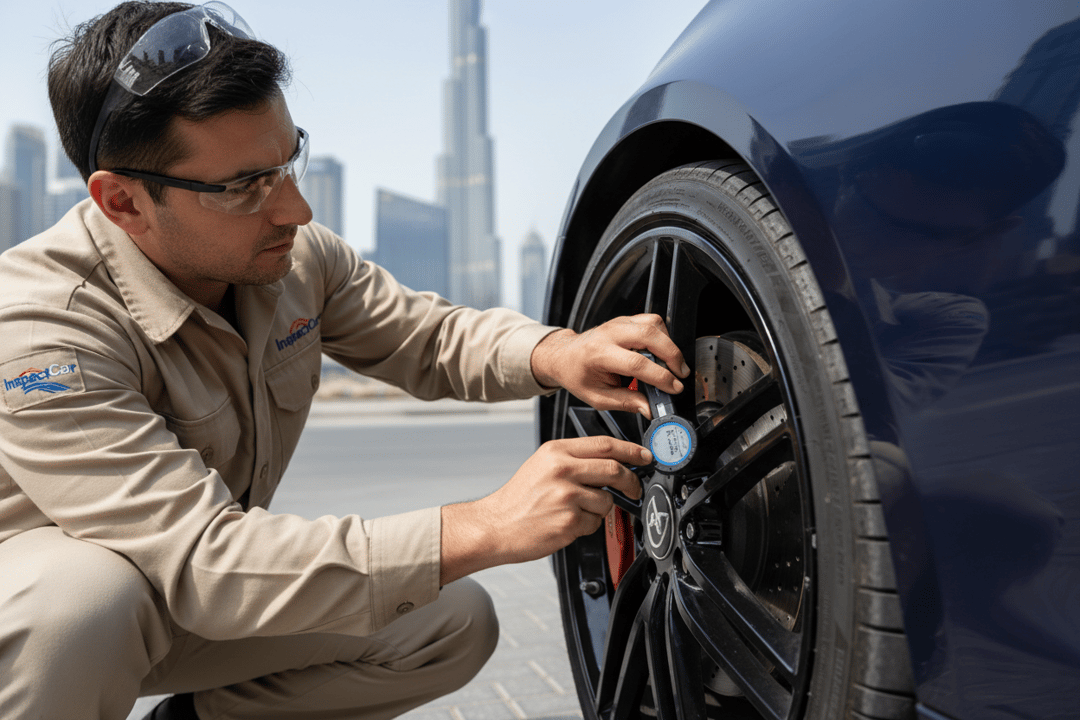
Four states: Good, Wear (under 4mm), Worn out, Uneven. Front pads do roughly 70 percent of the braking work. We measure remaining friction material with a depth gauge, anything under 4mm is approaching replacement, under 2mm is metal-on-metal soon. Uneven inner-versus-outer wear signals a sticking caliper slide pin. New OEM-quality front pads in the UAE: a notable sum to 900 depending on brand.
2. Rear Brake Pads
Four states. Rear pads on most modern cars wear slower than fronts, but on cars with electronic parking brakes (most German and Korean cars 2015 and newer) the rear pads can wear unevenly if the EPB motor seizes. We check both sides for thickness and parallel wear.
3. Front Brake Rotors
Four states: Good, Scoring, Warped, Below minimum. We measure rotor thickness with a micrometer against the manufacturer minimum spec stamped on the rotor edge. We also check for lateral runout, scoring, heat-discoloration (blue or purple tint), and lip formation at the outer edge. Warped front rotors cause steering-wheel vibration during braking, a common UAE complaint after Hatta or Jebel Jais runs. Replacement: a notable sum to 2,000 per pair depending on car.
4. Rear Brake Rotors / Drums
Four states. Rear rotors typically last 100,000+ km but rust pitting is common on cars parked for long periods at Dubai, Sharjah, or RAK airports. We check both surfaces and the parking-brake hat. On older drum-brake cars (some Toyota and Nissan light trucks) we measure drum diameter against the maximum machined spec.
5. Brake Shoes (Drum Brakes)
Three states: Good, Worn, N/A. Where fitted (typically rear of older Hilux, Vitz, Sunny, NV200) we pull the drum and measure shoe lining thickness, check for contamination from a leaking wheel cylinder, and verify the self-adjuster mechanism still works. Replacement: AED 250 to 600 per axle for shoes alone.
6. Front Brake Calipers
Three states: Good, Sticking, Seized. We check that both pistons retract and extend smoothly, that slide pins are not seized with corroded grease, and that there are no signs of fluid weeping from the piston seals. A seized front caliper is a top-three failure on UAE used cars over 8 years old, symptoms include the car pulling under braking and one wheel running noticeably hotter than the others. Replacement caliper: a notable sum to 1,800 per side; rebuild kit if the bore is clean: a notable sum to 500.
7. Rear Brake Calipers
Three states. Rear calipers with integrated parking-brake mechanisms are particularly prone to seizing in our climate because the EPB motor only cycles when the parking brake is engaged. Cars used in fleet service (rental returns) often have one or both rear calipers seized, a 2,000-AED finding the seller will not volunteer.
8. Brake Wheel Cylinders
Three states: Good, Weeping, Leaking, plus N/A. On drum-brake cars, the wheel cylinder pushes the shoes outward. We pull back the dust boot and check for fluid leakage, a wet boot is a failed cylinder, even if the brakes still work. A leaking wheel cylinder will eventually contaminate the shoe lining and require shoes plus cylinder. Replacement: a notable sum to 500 per cylinder.
9. Brake Master Cylinder
Three states: Good, Internal bypass, External leak. The master cylinder converts pedal pressure to hydraulic pressure. We check for external fluid leaks (look for fluid pooled on the brake-booster face), low fluid level in the reservoir (suggests internal bypass), and contaminated dark-brown fluid (overdue flush). A failing master cylinder gives a slowly sinking pedal with the car stopped at a traffic light. Replacement: a notable sum to 2,500.
10. Brake Booster
Three states: Good, Weak assist, Failed. The vacuum booster multiplies pedal effort. With the engine off, we pump the pedal five times to bleed vacuum, hold pressure on the pedal, then start the engine. The pedal should sink slightly as vacuum builds. No movement means a failed booster or a vacuum-line leak. UAE summer heat hardens the booster diaphragm, leading to premature failure on cars over 10 years old. Replacement: a notable sum to 4,500.
11. Brake Lines
Three states: Good, Surface rust, Pitted / leaking. Steel brake lines run along the underbody from master cylinder to each corner. We inspect for surface rust, pitting, or impact damage. UAE coastal vehicles (Sharjah Corniche, Ajman beach, Khor Fakkan) develop salt-corroded lines that can pin-hole under pressure. Replacement of one rusted line: a notable sum to 700.
12. Brake Hoses
Three states: Good, Cracked, Bulging / leaking. The flexible rubber sections at each wheel are a top failure point on UAE used cars. UV and heat crack the outer rubber, while internal layers can swell and create a one-way valve effect, the brake applies but the caliper does not release, dragging that wheel. We flex each hose and check for cracks, bulges, and weeping at the crimp fittings. Set of four hoses: AED 250 to 600.
13. Parking Brake
Three states: Holds, Weak, Does not engage. We test parking-brake hold on a slope. The car should hold without rolling and release cleanly. On cars with electronic parking brake we listen for the motor cycling and verify the dashboard light extinguishes. Frozen EPB motors are a common a notable sum to 2,500 fault on Korean and German cars.
14. Parking Brake Cable
Three states: Good, Stretched, Seized / frayed, plus N/A. On mechanical handbrake cars, we pull the cable adjustment under the car and check for fraying at the housing entry, rust binding, and proper free travel. A stretched or seized cable is a routine MOH safety failure. Replacement: a notable sum to 900 per cable.
15. ABS System
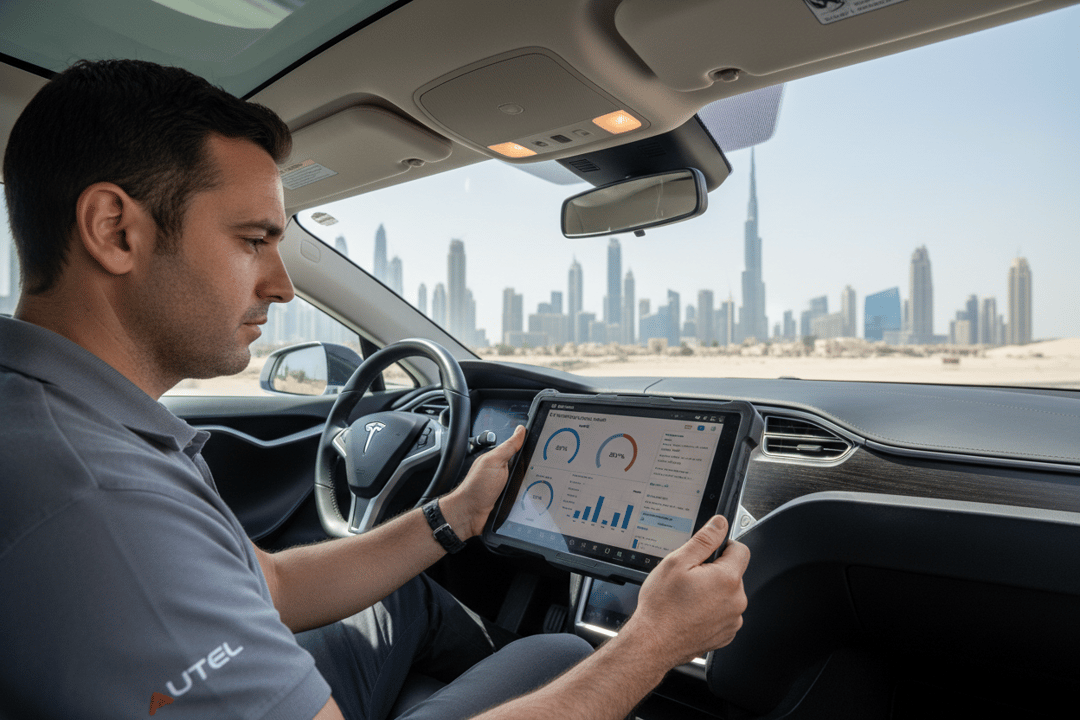
Three states: OK, Code stored, Warning light on. We connect our Autel MaxiSys MS909 OBD scanner and read the ABS module for stored and pending codes. A wheel-speed-sensor fault is the most common ABS code in our region, often caused by sand getting between the tone ring and sensor. ABS warning light on means the safety system is offline: sometimes a notable sum sensor fix, sometimes a notable sum+ ABS pump.
16. Brake Pedal Feel
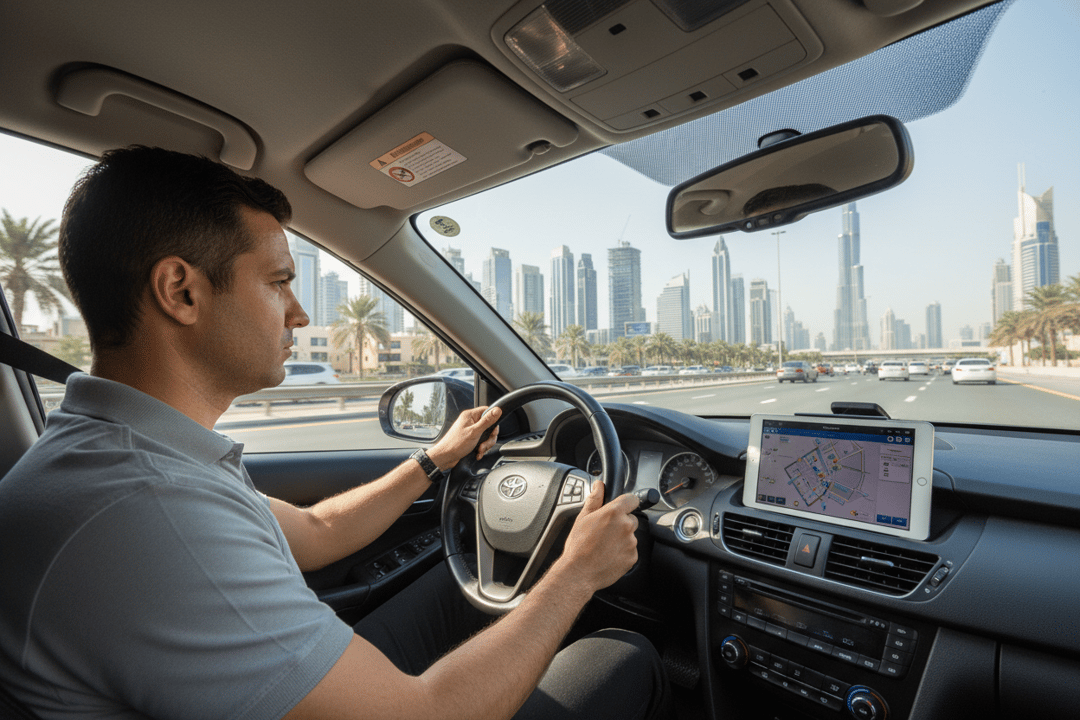
Four states: Firm, Spongy, Sinking, Hard / wooden. We test pedal feel three ways: pumping rapidly (should not sink), holding firm pressure for 30 seconds (should not creep down), and a hard stop from highway speeds (should be progressive, not grabby or wooden). Spongy pedal usually means air in the lines or moisture-saturated fluid; a sinking pedal means master cylinder; a hard pedal with weak braking means a failed booster.
Patterns the brake inspection reveals
- Soft pedal + dark fluid + no service records: moisture-saturated brake fluid plus likely glazed pads. a notable sum flush plus a notable sum pads, and the pedal still might not be right until calipers are inspected.
- Steering vibration on braking + warped front rotor + uneven pad wear: sticking caliper hammered the rotor flat-warped. Replace rotor and rebuild or replace caliper together. a notable sum to 3,500.
- Rear pads worn out + EPB warning light + one wheel hot: classic seized EPB caliper. a notable sum to 2,500 per side and the failure usually drags the matching pad to zero.
- ABS light on + corroded sensor connector + sand-packed tone ring: typical desert vehicle. Clean and reseal: a notable sum to 400. Ignored too long: full sensor replacement plus a wheel-bearing assembly: a notable sum to 2,000.
What each brake finding might cost
- Front pads + rotors: 1,200 to 2,800 AED.
- Rear pads + rotors: 900 to 2,200 AED.
- Single seized caliper: 600 to 1,800 AED.
- Brake fluid flush: 180 to 350 AED.
- Replace one corroded brake line: 400 to 700 AED.
- Brake hoses (set of four): 250 to 600 AED.
- Master cylinder: 800 to 2,500 AED.
- Brake booster: 1,500 to 4,500 AED.
- Wheel-speed sensor: 150 to 600 AED.
- ABS module: 2,500 to 5,500 AED.
- Electronic parking-brake actuator (per side): 1,200 to 2,500 AED.
- Parking-brake cable: 350 to 900 AED.
Book the inspection before the deposit
Brake repairs are the most common a notable sum-plus surprise on a used car in the UAE, and the easiest for a seller to mask in a 10-minute test drive on smooth flat roads. The 30-second pedal-hold test, the slope test, and the OBD ABS scan together take 8 minutes and tell you whether the car is one fluid flush from safe or one sinking pedal from a tow truck.
Our inspector comes to the car in Dubai, Sharjah, Ajman, Ras Al Khaimah, and Umm Al Quwain. The brake inspection is part of our chassis and body-on-the-lift checks, included in our full 410-plus-point pre-purchase inspection. Two to three hours on site. Digital report within 24 hours.
Take this 16-point list with you. Brake hard from highway speeds on a quiet street. Hold the pedal firmly at the next traffic light. Honest sellers will let you. The others will rush the test drive, that is the answer telling you to slow it down.
0 Comments
No comments yet. Be the first to share your thoughts!