

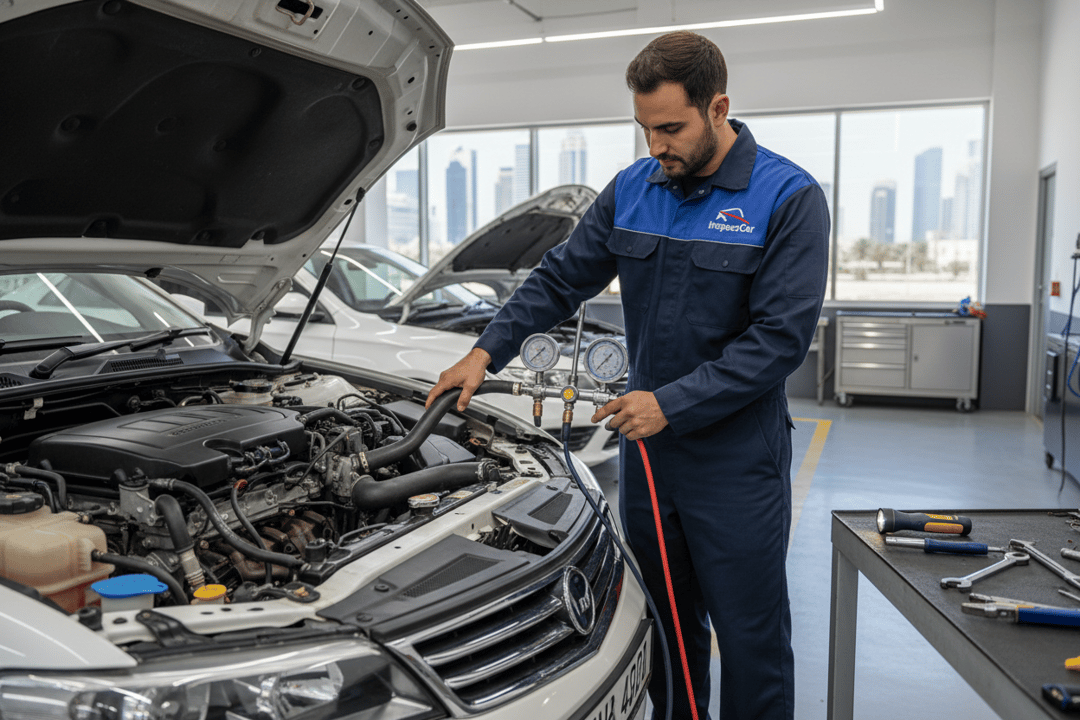
The cooling system on a UAE car is asked to do more than the engineers in Stuttgart, Tochigi, or Ulsan ever planned for. A 50-degree ambient air temperature, an air-conditioning compressor pulling 6 to ample power constantly, and a city-traffic duty cycle that keeps coolant temperatures hovering near the redline, all of it adds up to thermal stress that ages every cooling-system component faster than the manufacturer's service intervals assume.
This is the fourteenth category in our 25-category, 410-plus-checkpoint inspection. Eight focused checks performed bonnet-up with the engine warm, each one of them a clear pass-or-fail signal about whether the cooling system will survive the buyer's first UAE summer.
Why cooling failures are engine-killers in the UAE
An engine that overheats once at 130 degrees Celsius coolant temperature can survive, barely. An engine that overheats twice usually does not. The aluminium head warps, the head gasket fails, the piston rings lose their seal, and within 200 kilometres the engine is making metal-on-metal noise.
The cooling system is what keeps that catastrophic event from happening on a hot afternoon in July. A small leak: a loose hose clamp, a weeping water pump, a corroded radiator pinhole, is not a "fix it later" item in the UAE. It is the early warning the buyer should act on before the system loses pressure during a real heat-load event.
The 8 cooling checkpoints below catch every story before the deposit is paid.
The 8 cooling system checkpoints
1. Radiator Condition
Four states: No Visible Fault, Dirty, Damaged, Leaking. We open the bonnet and inspect the radiator core from the front (between the grille slats and the AC condenser). We look for: bent fins (kerb impact, stones, debris), oil stains on the surface (a sign that the engine has been running with an oil leak), white-or-pink crusty residue at the corners (coolant seeping and evaporating), and visible bulges or pinholes in the radiator tanks at top and bottom.
- Bent fins covering 5 to 15 percent of the core surface: reduces cooling efficiency by 10 to 25 percent. Comb out and clean: 200 to 600 AED.
- Crusty residue at the side tanks: the plastic side tanks are starting to leak at the seam where they crimp onto the aluminium core. This is a known failure mode on most Asian and German cars after 7 to 10 years. Replacement: 1,500 to 6,000 AED.
- Active drip or wet underside: radiator must be replaced or professionally repaired before the car is driven again in summer.
2. Radiator Cap
Three states: Good, Worn, Faulty. The pressure-rated cap on the coolant overflow tank (most modern cars do not have a cap directly on the radiator). The cap holds system pressure at the manufacturer-rated level, typically 1.0 to 1.4 bar. A weak cap releases pressure too early, which lowers the coolant boiling point and triggers overheating under heavy load.
We inspect the rubber seal on the underside of the cap. A flat, hardened, or cracked seal is past its serviceable life. Replacement: 50 to 250 AED. The cheapest single repair on the cooling system, and the most-skipped.
3. Cooling Fans
Three states: Working, Noisy, Not Working. We start the engine, switch on the AC at maximum, and watch the fans behind the radiator. The condenser fan should engage almost immediately when AC is on; the main cooling fan should engage when coolant temperature climbs past about 95 degrees Celsius.
- Fan does not engage at all: failed motor, blown fuse, or broken temperature sensor input. The car will overheat in city traffic within minutes. 600 to 4,500 AED depending on whether the fan assembly is a single motor or a multi-fan module on premium German cars.
- Fan engages but runs at one speed only: the variable-speed control module has failed. Often a precursor to total failure. 1,200 to 3,500 AED.
- Fan grinds or rattles: bearing failure. Replace before the fan blade contacts the radiator and destroys both.
4. Water Pump
Four states: Working, Noisy, Leaking, Needs Replacement. The water pump circulates coolant through the engine and radiator. It is driven either by the serpentine belt (older designs), the timing belt (interference-engine designs), or by an electric motor (most German cars 2015+).
We listen for: a grinding bearing noise from the pump area, a high-pitched whine that rises with engine speed, and inspect the small "weep hole" on the underside of mechanical pumps. The weep hole is a manufacturer-designed early warning, if coolant is dripping from it, the internal seal is failing and the pump is days or weeks from total failure.
- Belt-driven water pump weeping: 1,200 to 3,500 AED to replace.
- Timing-belt-driven water pump weeping: the timing belt must come off to access the pump. 2,500 to 6,500 a notable sum and good practice to replace the timing belt at the same time (do not skip this).
- Electric water pump on German cars: 4,500 to 12,000 AED. Known failure point on BMW N20/N52, Audi 2.0T, Mercedes M271/M272.
5. Coolant Overflow Tank
Three states: Good, Cracked, Leaking. The translucent plastic reservoir that holds the coolant expansion. UAE summer heat ages this plastic faster than European climates, by year 5 to 7, the tank goes from clear to yellowed, and stress cracks appear at the cap threads and the hose ports.
We squeeze the tank gently with the engine cold. A healthy tank deflects slightly and bounces back. A failing tank shows visible cracks, especially at the top where the cap threads on. Replacement: 400 to 2,500 AED depending on whether the tank is a one-piece moulding or part of a multi-line manifold.
A tank that cracks while the engine is hot vents pressurized coolant under the bonnet, a real fire risk, and an instant overheating event.
6. Cooling Hoses
Four states: Good, Soft, Cracked, Leaking. We squeeze each major coolant hose between thumb and forefinger with the engine off and warm. Healthy hoses feel firm and rebound; failing hoses feel soft, swollen, or have soft spots in the middle of an otherwise firm length.
- Soft hose with localised swelling: the inner rubber liner is delaminating. The hose can split open without warning at full operating pressure. 200 to 1,200 AED per hose, plus labour and a coolant flush after replacement.
- Cracks visible on the outer surface: normal age-cracking. Inspect the inside if possible; if the inside is also cracked, replacement is overdue.
- Bulges where a hose meets a metal pipe: the clamp is too tight and is cutting into the hose. Loosen and reposition; check for impending tear.
- Coolant residue at any hose-to-pipe junction: active leak under pressure.
UAE-specific note: silicone hoses sold as "performance upgrades" in the local aftermarket are sometimes fitted to mask a chronic leak from the original rubber hose. We always check that hoses match the original specification, silicone hoses on a non-performance car often signal a previous overheating event.
7. Hose Clamps
Three states: Good, Loose, Corroded. The metal clamps that secure each hose to its pipe fitting. We check that every visible clamp is tight, properly seated, and free from rust.
- Loose clamp at a junction: the system loses pressure intermittently, especially when the coolant is hot. Tighten, but if the hose has already been damaged by movement, the hose may need replacing too.
- Spring-tension clamps that have lost spring force: common on cars over 8 years old. The clamp is still in place but no longer maintaining the design clamp force. Replacement with a proper worm-drive clamp: 30 AED per clamp.
- Heavily corroded clamp: the rust has eaten the clamp band thin. Will fail soon under pressure. Replace.
8. Coolant Leaks
Three states: None, Minor, Major. The catch-all for any visible coolant evidence found during the inspection. We map every drip, every wet spot, every crusty deposit to its source: pump, hose, gasket, radiator, water-pump pulley, thermostat housing, or heater core.
- None: no visible coolant residue anywhere in the engine bay or under the car.
- Minor: small dampness at one location, no drips on the ground, no coolant smell. Note for monitoring.
- Major: visible drips, fresh wetness, coolant smell strong, or pressure-test fails. Repair before delivery, not after.
UAE buyer note: a car presented at viewing with visibly wet engine components, even from a "recent wash", should always be re-inspected after 24 hours of being parked dry. A clean engine bay was prepared for the viewing; what shows up overnight is what you would have inherited.
Patterns the cooling inspection reveals
Three or more cooling findings together rarely happen by chance:
- Radiator side-tank residue + soft upper hose + low coolant level: the system has been losing coolant for months. The seller has been topping up rather than fixing. Repair: 2,000 to 6,000 AED across radiator, hose, and coolant flush.
- Water-pump weep + brown coolant + cracked overflow tank: long-term cooling neglect across multiple components. Total replacement bill: 4,500 to 12,000 AED. The seller is "selling the problem" before it becomes their bill.
- Aftermarket silicone hoses + replacement radiator + recent service receipts: the car had a previous overheating event and was repaired. Verify head-gasket condition through the OBD long-term-fuel-trim values and the engine-oil colour from the fluids inspection. If any of those flag, walk away.
- Cooling-fan running constantly at idle even with cool coolant: the temperature sensor is in fail-safe mode. The car will not overheat (good), but the fault must be cleared before the alternator can keep up with the constant fan load.
How we actually test the cooling system in 8 minutes
Our inspectors use:
- A digital coolant-pressure tester that adapts to the radiator cap port. We pressurize the cold system to specified pressure and watch for any drop over 60 seconds. A drop indicates a leak somewhere, we then trace it visually.
- An infrared temperature gun to confirm even temperature distribution across the radiator core. A radiator with cold spots has internal blockage from old corrosion; a radiator with hot spots has air pockets from a previous bleed-procedure failure.
- A coolant refractometer for measuring freezing point, which actually measures coolant strength even in our climate (a refractometer reading near 0 means tap water has been used to top up, not coolant).
- The MS909 OBD scanner for live coolant temperature, fan duty cycles, and any stored P0115/P0116/P0117 (coolant temp sensor) or P0128 (thermostat) codes.
The pressure test is the single most informative cooling check we do, it finds leaks that no visual inspection can spot.
What each cooling finding costs you
Rough negotiation guidance for the UAE used-car market:
- Radiator fin combing and clean: 200 to 600 AED.
- Radiator replacement: 1,500 to 6,000 AED.
- Radiator cap: 50 to 250 AED.
- Cooling-fan motor or assembly: 600 to 4,500 AED.
- Cooling-fan control module: 1,200 to 3,500 AED.
- Belt-driven water pump: 1,200 to 3,500 AED.
- Timing-belt-driven water pump (with timing belt service): 2,500 to 6,500 AED.
- Electric water pump (BMW/Audi/Mercedes): 4,500 to 12,000 AED.
- Coolant overflow tank: 400 to 2,500 AED.
- Single coolant hose (upper or lower): 200 to 1,200 AED installed.
- Full coolant flush: 800 to 2,500 AED (also see fluids inspection).
- Pressure test by workshop: 150 to 400 AED.
What the InspectCar cooling report shows you
Every one of the 8 cooling-system checkpoints is rated on the same five-tier scale used across the rest of the inspection: Excellent, Good, Minor, Major, or Other. We record the live coolant temperature at idle and at 2,000 RPM, the fan engagement temperature, the pressure-test result over 60 seconds, and any stored coolant-system OBD codes. Photographs document every leak source, every soft hose, and every cracked tank.
The report is delivered as a shareable digital link, valid for 90 days. Forward it to the seller during negotiation, save it for warranty documentation, or share it with a workshop for an independent quote.
Book the inspection before the deposit
The cooling system is the engine's lifeline in a UAE summer, and one of the cheapest categories to maintain proactively but the most expensive to ignore. A 200-AED radiator cap that fails on a 50-degree afternoon can become a 25,000-AED engine replacement by the time you reach the next exit on Sheikh Zayed Road.
Our inspector arrives at the car wherever it is: Dubizzle listing, dealer lot, seller home: across Dubai, Sharjah, Ajman, Ras Al Khaimah, and Umm Al Quwain. The cooling-system inspection is part of the Body & Computer Inspection and the full Comprehensive 410-plus-checkpoint inspection. Two to three hours on site. Digital report within 24 hours.
Bring this 8-point list to your next viewing. Open the bonnet. Squeeze the hoses. Look for residue. Listen at idle. The honest sellers will let you do all of that. The others will tell you "the cooling system is fine, the AC blows cold", which is the answer that tells you to insist on a pressure test.


0 Comments
No comments yet. Be the first to share your thoughts!