

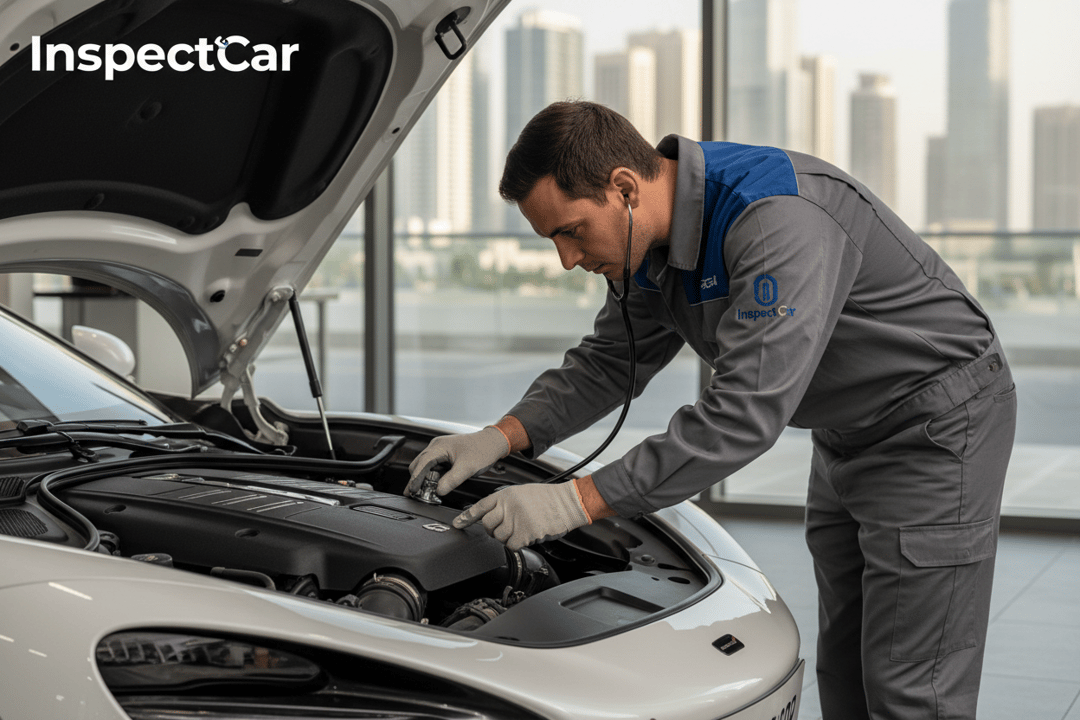
An engine reveals everything in the first 90 seconds, to someone who knows what to listen for. Cold start, a clean idle, a steady tachometer needle, no exhaust smoke at the first throttle blip. Or: a one-second hesitation before the engine catches, a faint blue cloud at the exhaust on first start, a tick that fades after thirty seconds of running. Each of those is a clear signal, not an opinion, about the condition of the most expensive single component on the car.
This is the eleventh category in our 25-category, 410-plus-checkpoint inspection. Twelve focused checks performed bonnet-up with the engine running, each one of them a clear pass-or-fail signal about the long-term health of the engine you are about to buy.
Why the engine decides the deal in the UAE used-car market
An engine repair on a used car is rarely a small bill. A worn timing chain on a modern direct-injection engine is 4,000 to 12,000 AED. A failed turbocharger is 6,000 to 22,000 AED. A rebuilt cylinder head is 8,000 to 25,000 AED. A complete engine replacement on most premium German or Japanese vehicles is 25,000 to 80,000 a notable sum often more than the car is worth on resale.
Two facts make UAE engines age faster than European ones. First, ambient heat: an engine running in a 50-degree environment is at the high end of its design envelope every time it works hard. Oil thins, gaskets shrink, and seals dry-out. Second, idle hours: AC at full blast in city traffic means the engine spends a lot of time at idle under load, wear pattern that accelerates piston-ring and timing-chain stretch.
The 12 engine checkpoints below catch every story before the deposit is paid.
The 12 engine checkpoints
1. Engine Overall Condition
Four states: No Visible Fault, Good, Average, Needs Attention. We perform a full visual sweep of the engine. We look for: oil-stain colour and pattern (fresh black is current; tan-coloured stains are baked-on and old), aftermarket components that are not factory original, and signs of recent disassembly such as scratches around bolt heads, missing dust covers, or new gaskets next to old ones (telltale of recent partial repair).
Aftermarket parts are not deal-breakers, but they need to be disclosed and tested. A car claiming "factory engine" with an aftermarket intake manifold has had work the seller did not mention.
2. Engine Sound
Four states: No Noise, Slight Noise, Knocking, Severe Noise. With the engine at idle, bonnet up, we listen with a mechanic's stethoscope at six locations: valve cover (top), timing-chain cover (front), oil pan (bottom), water pump (front-side), alternator (top-side), and accessory-belt tensioner (top).
- Light ticking, regular: hydraulic lifter waking up. Should clear within 60 seconds on a healthy engine. Persists on a worn one.
- Knocking, deep, rhythmic at idle: rod-bearing wear or low oil pressure. This is the single most expensive engine sound to hear, engine-out work territory. 8,000 to 25,000 AED minimum.
- Whining, rises with RPM: failing turbocharger or supercharger bearing.
- Hissing, constant: intake manifold gasket or vacuum leak.
- Squealing at startup, fades: cold piston slap, common on aluminium-block engines, usually not damaging if it clears.
3. Engine Mounts
Three states: No Visible Fault, Worn, Broken. We have a colleague hold the brake firmly while we shift between Drive and Reverse with the engine running, and we watch the engine. A healthy engine moves slightly with each shift, a worn mount lets the engine lurch noticeably forward or backward, sometimes by 4 to 8 cm.
Worn mounts cause vibration on the driver's seat at idle, especially with AC on (compressor load increases the rocking force). Replacement: 800 to 3,500 AED depending on whether it is a single mount or a set, and whether the mounts are hydraulic (luxury vehicles) or solid rubber.
4. Engine Vibration
Three states: Normal, Slight, Excessive. We place a hand on the dashboard and the steering wheel separately while the engine is at idle. A healthy 4-cylinder engine produces minor steady vibration; a 6-cylinder is barely felt; a V8 is almost imperceptible. Excessive vibration on any engine type points to: misfire on one cylinder (cross-reference with OBD codes), worn engine mounts (checkpoint 3), or fuel-trim issues (rich or lean condition).
5. Valve Cover Gasket
Three states: No Visible Fault, Seeping, Leaking. We inspect around the perimeter of the valve cover (the cover on top of the engine, often labelled with the engine name).
- Seeping: dark damp residue around the gasket but no drips. Common on engines over higher mileage. Repair: 300 to 1,500 AED.
- Leaking: visible oil drips, oil spreading down the engine block. Will eventually contaminate the spark-plug wells (causing misfires) and the alternator (shorting it out). Repair: 800 to 3,000 AED depending on engine type.
UAE summer heat dries valve cover gaskets faster than European climates. Most cars over 5 years old in the UAE need a valve cover gasket replacement at some point, the question is whether the seller has done it recently or is leaving it for you.
6. Oil Drain Plug
Three states: Good, Stripped, Leaking. We check the drain plug at the bottom of the oil pan. A clean plug seated properly means recent service was done correctly. A plug with damaged threads (visible flat spots, cross-threading, or tool-marks) means a previous oil change was rushed by an inexperienced mechanic, and the next oil change may strip the threads completely. Stripped pan threads require either an oversize plug (200 AED if it works) or a complete oil pan replacement (1,200 to 4,000 AED with labour).
7. Oil Pressure
Three states: Normal, Low, High. With the engine at operating temperature, we monitor the oil-pressure gauge or the oil-pressure warning behaviour at idle. On most modern cars without a dashboard pressure gauge, we read live oil-pressure data through the OBD scanner.
- Normal idle pressure: typically 1.5 to 2.5 bar at warm idle on most engines.
- Low pressure (under 1.0 bar at warm idle): worn oil pump, worn main bearings, or wrong oil viscosity. Catastrophic if not addressed within days.
- Pressure light flickers at idle: early stage of low-pressure problem. Diagnose immediately.
8. Engine Oil Seals
Three states: No Visible Fault, Seeping, Leaking. We inspect three external seals: the front crankshaft seal (front of the engine, behind the crank pulley), the rear main seal (between engine and transmission, accessible from below), and the camshaft seals (top of the engine, behind the timing cover). All three should be dry.
- Front crankshaft seal seeping: 800 to 3,500 a notable sum the timing cover usually needs to come off.
- Rear main seal leaking: 4,500 to 12,000 a notable sum the transmission must be removed for access. The single most expensive small leak on the car.
- Camshaft seals seeping: 1,200 to 4,500 AED depending on engine layout.
9. Engine Wiring
Three states: Good, Worn, Damaged. We follow the main wiring harness from the engine bay through to the firewall, looking for: chafed insulation against engine components, melted insulation near the exhaust manifold, and aftermarket splices (twisted-and-taped connections rather than proper crimps).
Aftermarket splices are forensic clues, they almost always indicate a previous repair where the original harness was damaged (often by a previous accident or by rodent damage in a parked car). Damaged engine wiring causes intermittent fault codes that drive owners crazy and resist diagnosis. Repair: from 600 AED for a single connector to 8,000 AED for a complete harness section.
10. Turbocharger
Four states: Working Fine, Noisy, Leaking, N/A. For turbocharged engines only. We listen for the characteristic turbo whine during a controlled throttle blip, it should be smooth and rise cleanly with RPM. Then we inspect the turbo housing for: oil residue at the compressor inlet (failing turbo seal, major issue), excess shaft play (we wiggle the compressor wheel through the intake side; any movement larger than 0.5 mm is a worn turbo bearing), and blue smoke during full-throttle acceleration (turbo seal failure leaking oil into the intake).
Turbo replacement on UAE cars: 6,000 to 22,000 AED for the unit, plus labour. Some modern engines (Mercedes M-series, BMW B-series) require complete intake-manifold removal for turbo access, adding 4 to 8 hours of labour.
11. Supercharger
Three states: Working Fine, Noisy, N/A. For supercharged engines (e.g. Range Rover, Jaguar, AMG models). The supercharger is belt-driven, so it makes a different sound than a turbo, a higher-pitched whine that varies linearly with RPM. We listen for: rattling at idle (broken internal coupler), grinding (worn rotor bearings), and oil residue at the body of the unit (internal seal leak).
Supercharger rebuild: 8,000 to 25,000 AED. Major negotiation point.
12. Exhaust Smoke
Four states: None, White, Blue, Black. We watch the exhaust closely during cold start and during a hard throttle blip with the engine at operating temperature.
- None at idle, none at acceleration: healthy engine.
- Light white at cold start, clears within 30 seconds: normal water condensation, especially in cooler UAE morning weather.
- Persistent white smoke (sweet smell): coolant entering the combustion chamber. Head-gasket failure or cracked head. 8,000 to 25,000 AED.
- Blue smoke at start, fades: oil seeping past valve stem seals overnight. Repair: 2,500 to 8,000 AED.
- Blue smoke under acceleration: piston-ring wear or turbo seal failure. Cross-reference with checkpoint 10 (turbocharger). 8,000 AED to engine replacement.
- Black smoke under acceleration: engine running rich. Could be a 200-AED MAF cleaning, a 1,500-AED injector replacement, or a 5,000-AED fuel-system overhaul.
Patterns the engine reveals across all 12 checks
Three or more engine findings together rarely happen by chance:
- Knocking + low oil pressure + blue smoke under acceleration: rod-bearing wear and piston-ring failure together. This is engine-replacement territory. Walk away unless the price reflects it.
- Light ticking + valve cover seeping + camshaft seal seeping + occasional pressure-light flicker: the engine has been run on extended oil intervals. The oil galleries are partially blocked. Aggressive flush + new oil + new gaskets recommended. 3,000 to 8,000 AED of deferred maintenance.
- Engine vibration + worn mounts + irregular idle: a misfire on one cylinder is shaking the engine, and the worn mounts are amplifying it. The misfire root cause must be diagnosed first (usually 600 to 2,500 AED), then mounts replaced (800 to 3,500 AED).
- Spotless engine bay (steam-cleaned) + fresh-looking gasket residue + recent oil change at non-dealer: the seller is hiding a leak that was cleaned up before listing. Expect to find the leak again within weeks. Insist on a workshop inspection on a hoist before deposit.
How we actually test the engine in 15 minutes
Our inspectors carry:
- A mechanic's stethoscope for engine-noise diagnosis at multiple points.
- An OBD scanner that streams live oil pressure, fuel trim, misfire counts, and turbo boost data.
- A clean rag to wipe-and-recheck oil seal areas, fresh wetness reappearing within a minute confirms an active leak.
- A bright LED inspection light for the back of the engine and the timing-cover area.
- A flexible inspection mirror for the rear-main-seal area and underside of the timing cover.
The full engine inspection takes 15 to 20 minutes once the engine is at operating temperature.
What each engine finding costs you
Rough negotiation guidance for the UAE used-car market:
- Light valve-cover seep: 300 to 1,500 AED.
- Active valve-cover leak: 800 to 3,000 AED.
- Worn engine mounts (set): 1,500 to 6,000 AED.
- Stripped oil drain plug: 200 to 4,000 AED depending on whether oversize plug works or pan must be replaced.
- Low oil pressure investigation: 1,200 to 8,000 AED (best case is sender unit, worst case is bearings).
- Front crankshaft seal: 800 to 3,500 AED.
- Rear main seal: 4,500 to 12,000 AED.
- Damaged engine wiring section: 600 to 8,000 AED.
- Failed turbocharger: 6,000 to 22,000 AED.
- Failed supercharger: 8,000 to 25,000 AED.
- Head gasket / cracked head (white smoke): 8,000 to 25,000 AED.
- Knocking engine: 25,000 to 80,000 AED (engine replacement). Walk away.
What the InspectCar engine report shows you
Every one of the 12 engine checkpoints is rated on the same five-tier scale used across the rest of the inspection: Excellent, Good, Minor, Major, or Other. We record stored fault codes from the OBD, live oil pressure data, observed exhaust smoke colour at cold start and at full throttle, and any visible leak locations. Photographs document every finding: a damp valve cover, a stripped drain plug, an aftermarket harness splice, a residue trail from a turbo seal.
The report is delivered as a shareable digital link, valid for 90 days. Forward it to the seller during negotiation, save it for warranty documentation, or share it with a workshop for an independent quote.
Book the inspection before the deposit
The engine is the single most expensive component on a used car, and the most-misrepresented in UAE listings. "Engine perfect, no issues" is the most common phrase in Dubizzle ads. The 12 checks above are how a trained inspector verifies, or refutes, that claim in 15 minutes.
Our inspector arrives at the car wherever it is: Dubizzle listing, dealer lot, seller home: across Dubai, Sharjah, Ajman, Ras Al Khaimah, and Umm Al Quwain. The engine inspection is part of the Body & Computer Inspection and the full Comprehensive 410-plus-checkpoint inspection. Two to three hours on site. Digital report within 24 hours.
Bring this 12-point list to your next viewing. Listen at idle. Watch the exhaust on cold start. Check for visible oil residue. Pull live data through OBD if you can. The honest sellers will let you do all of that. The others will rush you to "drive and feel it", which is the answer that tells you to slow down.




0 Comments
No comments yet. Be the first to share your thoughts!