
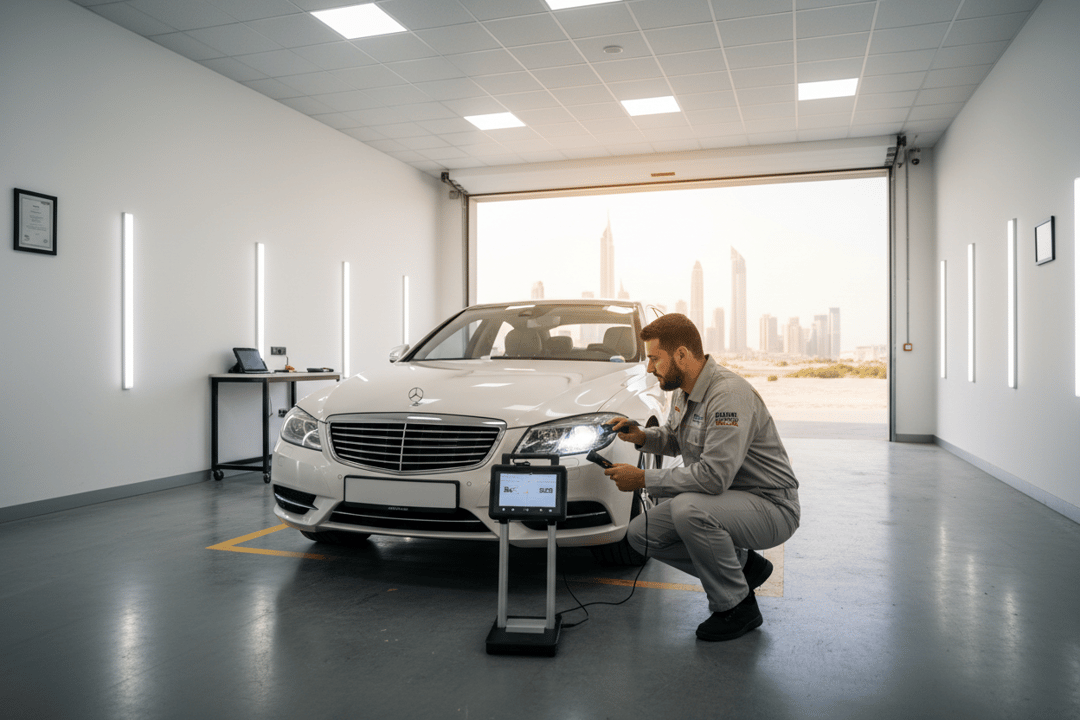
Lighting is the part of a car most owners only test at night, after they have already paid the deposit. Yet a properly executed lighting inspection, done in five minutes, in a covered car park or any shaded space, reveals more about the electrical health of a used car than almost any other quick check. Burnt bulbs hint at chronic voltage spikes. Mismatched headlight colour suggests one side was replaced after a front-end hit. A flickering tail light points to a corroded ground in the rear harness, often from prior water ingress.
This is the fifth category in our 25-category, 410-plus-checkpoint inspection. Seventeen focused checkpoints, each one of them either pass or fail, each one of them a real expense if you miss it.
Why exterior lights tell the electrical truth about a used car
Every external bulb in a modern car is wired through the body control module (BCM) and protected by either a fuse or a smart-power transistor. When a bulb burns out earlier than expected, when a turn signal blinks too fast (a hyper-flash signaling a dead bulb on the same circuit), or when a tail light dims under load, it is rarely just the bulb. It is the harness, the ground, the BCM output, or the chronic over-voltage from a failing alternator slowly cooking every bulb on the car.
UAE summer heat accelerates all of this. Headlight lenses haze. Connectors corrode under repeated thermal cycles. Plastic housings warp. A car that arrives at our inspection at 11 a.m. in July with three failed bulbs is not coincidence, it is a car that has been driven hard with a marginal charging system or a wet harness.
The 17 exterior lighting checkpoints
1. Headlights (Low Beam)
Four states: Working, Dim, One Out, Not Working. We turn the lights on, walk to the front, and look for: equal brightness left vs. right, equal colour temperature (a yellow-orange beam on one side and a cold white beam on the other means one bulb is original halogen and the other is aftermarket LED, a sign of replacement after damage), and proper aim (the cut-off line should be flat and below the eye-line of an adult standing 5 metres in front).
- Working but dim: almost always a clouded lens, not a weak bulb. Restoration kit: 80 to 250 AED if you do it yourself; 400 to 700 AED at a professional detailer.
- One side out: 50 AED bulb on a halogen car, but on an LED or HID-equipped vehicle the entire headlight assembly may need replacing. 1,500 to 12,000 AED.
- Both not working: rarely two bulbs simultaneously: usually a fuse, relay, or a BCM low-beam output. Diagnosis time at a workshop.
2. Headlights (High Beam)
Same four states. We flash the high beams while standing 5 metres in front of the car. On most modern vehicles the high beam is a separate filament inside the same bulb housing, so a working low beam with a dead high beam usually points to the bulb itself, the high-beam relay, or the multi-function stalk inside the steering column.
3. Automatic High Beams
Three states: Working, Not Working, N/A. We test by enabling auto-high-beam from the driver's stalk and pointing the camera (mounted to the rear of the rear-view mirror) at a phone screen showing a bright white image. The beam should drop within two seconds. If it does not, either the camera is uncalibrated (common after a windshield replacement), the firmware needs updating, or the system has been intentionally disabled to mask a fault.
4. Adaptive Headlights
Three states. Adaptive headlights swivel left and right with the steering wheel, illuminating around bends. We turn the steering wheel slowly with the lights on and watch the beams track. Failed actuators are common after off-road use or after the car has been driven through deep water, the motor inside the headlight is not waterproof, only splash-resistant.
5. Daytime Running Lights
Three states. Daytime running lights (DRLs) come on automatically when the engine starts. On modern cars they are LED strips inside the headlight assembly. A single dead segment on a DRL strip means the entire headlight unit needs replacing, individual LED chips are not separately serviceable on most brands. 2,000 to 8,000 AED depending on whether the car has standard, matrix, or laser headlights.
6. Front Turn Signals
Three states: Working, Fast Blink, Not Working. Fast blink is the classical "hyper-flash", it means one bulb on that circuit is burnt or has been replaced with a non-resistor LED. Both faults will fail the UAE annual inspection. The fix is either a new factory bulb (15 to 60 AED) or a load-resistor inline with each LED bulb (40 to 120 AED per side).
7. Rear Turn Signals
Same three states. Rear signal failures often coincide with rear-end collision repairs, the new tail-light assembly is fitted but its connector pins are bent, leaving the turn signal flickering or dead.
8. Side Mirror Turn Signals
Three states: Working, Not Working, N/A. The amber LED strip integrated into the side mirror housing is wired separately from the front turn signal. A dead mirror signal usually means a damaged wire inside the mirror harness, common after the mirror has been folded too aggressively in a tight underground car park.
9. Tail Lights
Four states: Working, Dim, One Out, Not Working. We turn on the parking lights and step behind the car. Both rear lamps should be the same brightness. A noticeably dim tail light usually points to a corroded ground in the harness, water has entered the trunk or the rear quarter at some point. This is one of the strongest forensic indicators of prior water damage we can verify in five minutes.
10. Brake Lights
Three states: Working, One Out, Not Working. With the engine running, we have a colleague press the brake pedal while we observe both rear lamps and the high-mount third brake light. All three should illuminate at full brightness within milliseconds.
- Brake light not working at all: usually the brake-light switch on the pedal arm. 80 to 250 AED. But it is a serious safety issue, the car is invisible to following traffic at night.
- One side out: bulb or harness. Diagnose first.
- Brake lights stay on permanently: brake-light switch stuck closed. The battery will drain overnight, and the cruise-control will not engage.
11. Third Brake Light
Two states: Working, Not Working. The high-mount third brake light is mandatory on every passenger car in the UAE. On most modern vehicles it is an LED strip embedded in the rear spoiler or the back of the cabin glass. A failed third brake light requires replacing the entire spoiler assembly on many models, 600 to 3,500 AED depending on whether the part is shared with adaptive cruise sensors.
12. Reverse Lights
Three states: Working, One Out, Not Working. We engage reverse with the engine running and the brake pressed (so the car does not move) and confirm both reverse lamps illuminate. Failed reverse lights are also a backup-camera issue, the camera relies on the reverse signal to activate. A car whose reverse camera does not come on usually has a reverse-light circuit fault behind it.
13. Fog Lights
Three states. Fog lights face the most physical abuse on the entire car, they sit lowest on the front bumper, closest to road debris, kerbs, and minor parking impacts. We test both fog lights on, look for cracks in the lens, and inspect the housing for water inside (a sealed fog light should be perfectly dry). Aftermarket fog lights are common and almost always fitted after a damaged factory unit was deemed too expensive to replace.
14. Hazard Lights
Two states: Working, Not Working. With the engine off, we press the hazard button and confirm all four corners flash in sync, plus both side-mirror signals. Hazard lights and turn signals share the same flasher relay and the same bulbs, but they are wired through a different switch path. A failed hazard system means a switch fault, not a bulb fault.
15. License Plate Lights
Two states. Two small bulbs above the rear license plate. Cheap, easy, and the most-failed bulbs on the entire car because they sit closest to road grit and water spray. Fail this checkpoint and the car will not pass UAE annual inspection. Replacement: 30 to 80 AED a pair, plus 5 minutes of labour.
16. Courtesy Lights (Mirrors / Handles)
Three states. The small puddle lights under the side mirrors and inside the door handles activate when the car is unlocked and the door is opened. Failed courtesy lights typically mean a corroded LED or a broken micro-switch, both repairs require disassembling the mirror housing or the door handle, so labour costs (300 to 900 AED) often exceed the part cost (60 to 200 AED).
17. Headlight Lens Condition
Four states: Clear, Hazy, Yellowed, Cracked. The polycarbonate plastic of headlight lenses degrades under UAE sun exposure, even three years of unprotected outdoor parking will yellow a clear lens. We rate each headlight separately; a clear lens on the left and a yellowed lens on the right indicates the left lens was replaced after a front-end impact while the right lens kept its original (and now sun-damaged) housing.
- Hazy: safe to drive but reduces beam reach by up to 40 percent at night. Restoration: 200 to 600 AED.
- Yellowed: deeper UV damage. Restoration may not fully clear the plastic; replacement headlight assembly: 1,500 to 12,000 AED depending on technology.
- Cracked: water will enter the housing within weeks. Always a replacement, never a repair.
What the pattern of failures tells an inspector
One bulb out is a maintenance item. Three or more failures across the car at the same time is a pattern, and patterns tell stories:
- Multiple bulbs dim: alternator producing low voltage, or the battery is dying and pulling system voltage down at every brake press.
- Multiple bulbs blown: alternator producing over-voltage spikes, silently destroying every bulb on the car. New alternator: 1,800 to 5,500 AED. Without it, every replacement bulb will fail again within months.
- All rear lights dim or flickering: corroded body ground at the rear bumper or trunk floor. Strong evidence of prior water damage.
- Mismatched colour temperature left vs. right: a previous front-end repair used aftermarket bulbs on one side. Cross-reference with front-bumper paint findings.
What each lighting finding costs you
Rough negotiation guidance for the UAE used-car market:
- Halogen bulb out (any single light): 30 to 80 AED. Negotiate 100 AED off the price as a goodwill gesture.
- LED segment dead in DRL or tail light: 1,500 to 6,000 AED for assembly replacement. Negotiate the full amount.
- Hazy or yellowed headlight lens: 400 to 700 AED restoration. Negotiate 500 AED.
- Cracked headlight housing: 1,500 to 12,000 AED. Walk or negotiate the full amount.
- Multiple bulbs failed (alternator pattern): 2,000 to 6,000 AED for alternator + bulbs. Negotiate the full repair budget.
- Brake-light switch faulty: 200 AED part, 300 AED labour. Negotiate 500 AED but flag that it is a safety item that should be fixed before delivery.
What the InspectCar lighting report shows you
Every one of the 17 lighting checkpoints is rated on the same five-tier scale used across the rest of the inspection: Excellent, Good, Minor, Major, or Other. Photographs document any failed bulb, hazy lens, or aftermarket assembly. Where applicable we also pull the relevant diagnostic codes through OBD, most modern vehicles log a stored fault for any bulb that has been out for more than 50 ignition cycles, even if the dashboard warning has been cleared.
The report is delivered as a shareable digital link, valid for 90 days. Forward it to the seller during negotiation, save it as a PDF for your records, or share it with a workshop for an independent quote.
Book the inspection before the deposit
Lighting failures are easy to fix one at a time, but the pattern of failures is what tells the real story of how a car has been used. A 30-minute electrical-systems inspection that includes all 17 of these lighting checkpoints: plus the other 9 categories of body, frame, and electronics, is the difference between buying a car and buying a year of slow, draining repair bills.
Our inspector arrives at the car wherever it is: Dubizzle listing, dealer lot, seller home: across Dubai, Sharjah, Ajman, Ras Al Khaimah, and Umm Al Quwain. Lighting is part of the Body & Computer Inspection and the full Comprehensive 410-plus-checkpoint inspection. Two to three hours on site. Digital report within 24 hours.
Bring this 17-point list to your next viewing. Even before you book a paid inspection, walking around the car with the seller while you press the brake, switch on the headlights, and engage the hazards will already tell you more than the seller hopes you will discover.
0 Comments
No comments yet. Be the first to share your thoughts!