
The fuel system is the most-overlooked safety system on a used car. Buyers test the brakes, the AC, the engine sound, and then assume the petrol just gets there somehow. The truth is that everything between the fuel cap and the injector is operating at high pressure, in a flammable environment, against UAE summer heat that ages every rubber seal and plastic line faster than the manufacturer's design.
This is the fifteenth category in our 25-category, 410-plus-checkpoint inspection. Six focused checks performed at the rear of the car and beneath the bonnet, each one of them a clear pass-or-fail signal about whether the fuel system is safe and reliable for the buyer's first year of ownership.
Why fuel-system faults are different from every other defect
A worn brake pad squeals before it fails. A failing alternator dims the lights before the battery dies. A bad water pump weeps for weeks before it gives out. The fuel system, by contrast, often fails without warning, a fuel pump that worked yesterday refuses to start the engine this morning, a fuel line that was fine last summer cracks in the middle of a Friday family trip and leaks petrol onto a hot exhaust.
Two UAE-specific factors compound this. First, fuel quality: even premium 98 RON in the UAE contains higher ethanol than it did 10 years ago, and ethanol attacks rubber seals over time. Second, ambient heat: a fuel pump pulling petrol against a 75-degree underbody temperature in July works at the upper edge of its design envelope every trip.
The 6 fuel-system checkpoints below catch every story before the deposit is paid.
The 6 fuel-system checkpoints
1. Fuel Door Operation
Three states: Working, Stiff, Not Opening. We press the fuel-door release button (or pull the dashboard release lever on older cars) and verify the door pops open cleanly. Then we close it and confirm it latches with a single push.
- Stiff door: the spring-loaded hinge has corroded from coastal humidity in Sharjah, Ras Al Khaimah, or Umm Al Quwain. Lubrication clears most cases for 50 to 200 AED.
- Door does not open from inside release: broken cable or failed solenoid (on cars with electric release). 300 to 1,200 AED depending on the design.
- Door does not close properly: often after a previous rear-end collision repair where the body shop did not realign the door panel correctly. Cross-reference with the frame inspection.
2. Fuel Cap
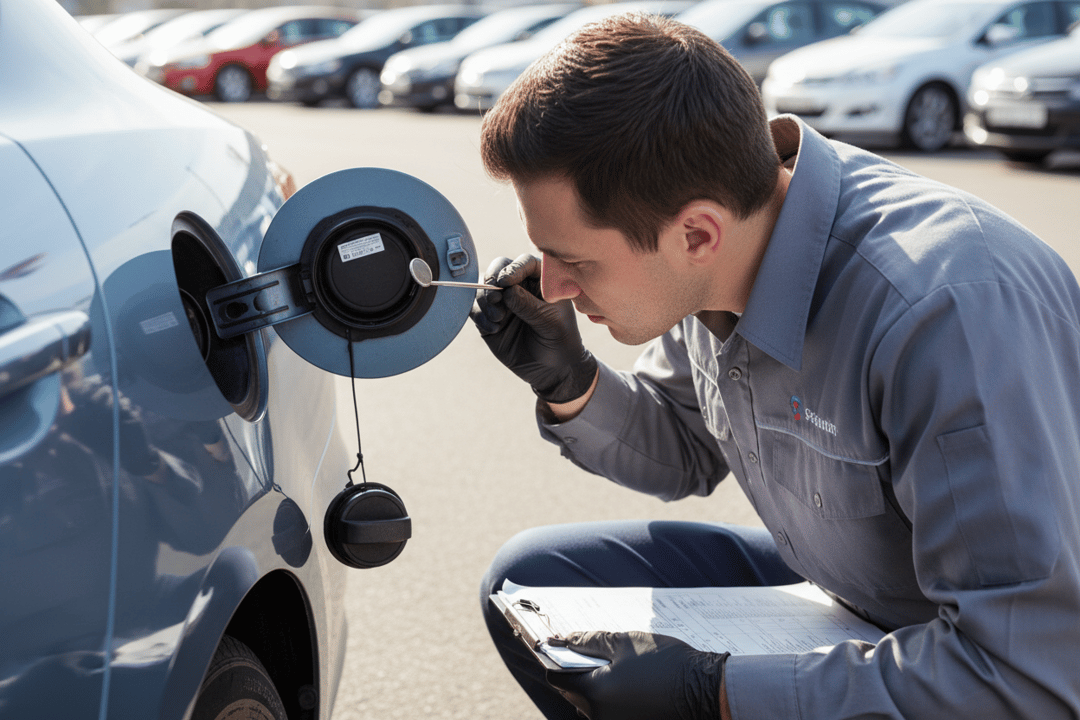
Four states: Good, Loose, Missing, Capless. We open the fuel filler door and check the cap. Most cars have a tethered cap with a pressure-rated rubber seal. We turn the cap counter-clockwise, it should give resistance, then click off cleanly. Reinstalling it should require 3 distinct clicks (this is the manufacturer-designed torque limit; clicks past 3 indicate a worn ratchet inside the cap).
- Loose cap: the rubber seal is cracked or hardened. The car will store an EVAP fault code (P0440/P0455/P0456), and the check-engine light will be on intermittently. New cap: 80 to 350 AED.
- Missing cap: rare but happens. The previous owner lost it and never replaced it; petrol vapours escape continuously and the EVAP system is permanently faulted. Replacement required to clear codes.
- Capless system (newer Ford and Lincoln models): verify the spring-loaded flap inside the filler neck closes properly when you remove the nozzle. If the flap is stuck open, vapours escape just like a missing cap.
Inspector tip: the fuel cap is the single cheapest check-engine-light cause on the car. A persistent intermittent CEL on a car with no other issues is almost always a fuel-cap problem the seller has been ignoring.
3. Fuel Tank
Four states: Good, Dented, Rusted, Leaking. We inspect the fuel tank from underneath the rear of the car (a hoist makes this easier; on-site we use a flashlight and inspection mirror). Modern fuel tanks are plastic on most cars, steel on some pickups and SUVs, and aluminium on a few performance cars.
- Dents in a plastic tank: cosmetic if shallow; structural concern if the dent is sharp enough to crease the plastic. Cracks can develop along crease lines.
- Rust on a steel tank: coastal humidity does this. Surface rust is normal and can be cleaned; deep flaky rust with visible pitting means the tank is failing from inside-out and replacement is urgent.
- Wet residue under the tank: active leak. Stop driving the car. Petrol on a hot underbody is a fire risk that does not need a second warning.
- Aftermarket plastic-coating spray on the tank: someone has tried to seal a leak from the outside. Almost always temporary, and almost always concealing a real problem.
4. Fuel Lines
Three states: Good, Worn, Leaking. We trace the fuel lines from the tank forward, past the fuel filter (where fitted as a serviceable item), along the underbody, into the engine bay, and to the fuel rail above the injectors. We look for: chafing where the line passes through metal clips, swelling or softness in rubber sections (a sign of ethanol attack), and visible wetness at any junction.
- Chafed line: a clip has come loose and the line is rubbing against a body member. Re-secure and inspect for any wear-through. 50 to 300 AED.
- Swollen or soft rubber section: ethanol-induced degradation. The rubber is becoming permeable to fuel. Replace before it ruptures. 400 to 1,800 AED for the section.
- Wet junction: active leak under high-pressure pump operation. Major safety issue. Repair before driving.
Modern direct-injection fuel systems run at 2,000+ psi at the high-pressure side. A leak at this pressure atomises fuel into a fine mist, invisible to the eye but extremely flammable. We use a small piece of paper or a UV-dye additive to find these leaks.
5. Fuel Pump
Three states: Working, Noisy, Weak. The in-tank fuel pump runs continuously while the engine is on. With the engine off and the key in the "ON" position (but not started), we listen for the 2-second priming whirr that the pump makes as it pressurizes the system. A healthy pump produces a steady, mid-pitched hum. A failing pump is louder, varies in tone, or makes a grinding sound.
Then with the engine running, we read fuel pressure live through the MS909 OBD scanner and watch for: pressure drops under sustained acceleration (a weak pump unable to keep up with engine demand), and slow pressure recovery when the throttle is released.
- Loud humming pump: the pump is working harder than designed, usually because the fuel filter is clogged. Filter replacement: 200 to 800 AED. If the filter is not the issue, the pump itself is wearing out.
- Pump pressure drops under acceleration: the pump is failing. Replacement: 1,200 to 4,500 AED for in-tank pumps; up to 8,000 AED for some German cars where the pump assembly includes the level sender.
- No priming sound at all when key is turned on: the pump has failed completely. The car will not start. 1,200 to 4,500 a notable sum plus possible roadside-recovery cost if the car is to be moved.
6. Fuel Smell
Three states: None, Slight, Strong. With the engine off and the bonnet open for 60 seconds, we smell the air around the engine bay and beneath the rear of the car. Then with the engine running for 5 minutes, we repeat, paying attention to the moments when the AC compressor cycles on and off (which can pull engine bay air into the cabin via the fresh-air intake).
- None: healthy fuel system, no air leak.
- Slight petrol smell at the rear of the car: the EVAP system is venting more than it should. Could be fuel cap, could be a charcoal canister failure, could be a small fuel-line leak. Diagnose immediately.
- Strong fuel smell anywhere: active leak. Stop the test. Do not drive the car until the source is found.
UAE-specific note: a petrol smell that becomes stronger when the car has been parked in direct sun for an hour, and weakens after the engine has been driven, is classic EVAP-system over-saturation, the charcoal canister has collected too much fuel vapour and is leaking it back into the engine bay. Replacement: 1,200 to 4,500 AED.
Patterns the fuel-system inspection reveals
Three or more findings together rarely happen by chance:
- Stored P0440/P0455/P0456 + slight petrol smell + worn fuel cap seal: EVAP system has been failing for months and the seller knows. New cap fixes the cheapest case (80 AED); a charcoal canister replacement is the worst case (4,500 AED).
- Loud fuel pump + hesitation under acceleration + stored P0171/P0174 lean codes from OBD: the pump is dying. Replace before it fails completely.
- Petrol smell + wet residue at rear underbody + recent receipts for "fuel-system service": the seller attempted a DIY repair on a leak and is selling the car before it gets worse. Walk away or insist on a workshop inspection on a hoist.
- Stiff fuel door + dented fuel tank + paint mismatch on the rear quarter panel: the rear quarter took a hit, the body shop straightened the panels, but the underlying tank impact was not addressed.
How we actually inspect the fuel system in 6 minutes
Our inspectors carry:
- The MS909 OBD scanner for live fuel-pressure data, EVAP system tests, and stored P04xx fault codes.
- A bright LED inspection light for under-car fuel-line tracing.
- A flexible inspection mirror for the top of the fuel tank where the pump assembly mounts.
- A small piece of plain white paper for finding fine high-pressure fuel mist leaks (the paper darkens visibly where fuel hits it).
- Our nose, by far the most sensitive detector for petrol vapour at low concentrations.
The full fuel-system inspection takes 6 to 10 minutes; the OBD-driven EVAP test adds another 5 minutes if the car supports manufacturer-level service tests.
What each fuel-system finding costs you
Rough negotiation guidance for the UAE used-car market:
- Stiff fuel door: 50 to 200 AED.
- Failed fuel-door release cable or solenoid: 300 to 1,200 AED.
- Worn fuel cap: 80 to 350 AED.
- Charcoal canister replacement (EVAP saturation): 1,200 to 4,500 AED.
- Fuel filter (where serviceable): 200 to 800 AED.
- Chafed fuel line clip-and-secure: 50 to 300 AED.
- Section of fuel line replacement: 400 to 1,800 AED.
- Fuel pump (Asian car): 1,200 to 4,500 AED.
- Fuel pump assembly (German premium): up to 8,000 AED.
- Fuel tank replacement: 1,500 to 8,000 AED for a steel tank; up to 12,000 AED for some plastic tanks integrated with EVAP plumbing.
- Active fuel leak (any source): safety-critical, repair before driving, regardless of cost.
What the InspectCar fuel-system report shows you
Every one of the 6 fuel-system checkpoints is rated on the same five-tier scale used across the rest of the inspection: Excellent, Good, Minor, Major, or Other. We record live fuel-pressure data, all P04xx EVAP-related codes, the priming-pump sound observation, and any visible leaks or stains. Photographs document every finding: a dented tank, a chafed line, a swollen rubber section, a stained underbody.
The report is delivered as a shareable digital link, valid for 90 days. Forward it to the seller during negotiation, save it for warranty documentation, or share it with a workshop for an independent quote.
Book the inspection before the deposit
Fuel-system issues are the most under-reported category in UAE Dubizzle listings. The car drives, the engine starts, the AC blows cold, and the buyer never thinks to check the petrol cap, the underbody, or the fuel-pump prime sound. Six minutes of focused inspection catches issues that ruin Friday family trips and create roadside-breakdown moments.
Our inspector arrives at the car wherever it is: Dubizzle listing, dealer lot, seller home: across Dubai, Sharjah, Ajman, Ras Al Khaimah, and Umm Al Quwain. The fuel-system inspection is part of the Body & Computer Inspection and the full Comprehensive 410-plus-checkpoint inspection. Two to three hours on site. Digital report within 24 hours.
Bring this 6-point list to your next viewing. Open the fuel door. Twist the cap. Listen for the priming whirr. Smell the air at the rear of the car. The honest sellers will let you do all of that. The others will say "the car was just refuelled, it might smell a bit", which is the answer that tells you to insist on a fuel-pressure read.





0 Comments
No comments yet. Be the first to share your thoughts!