

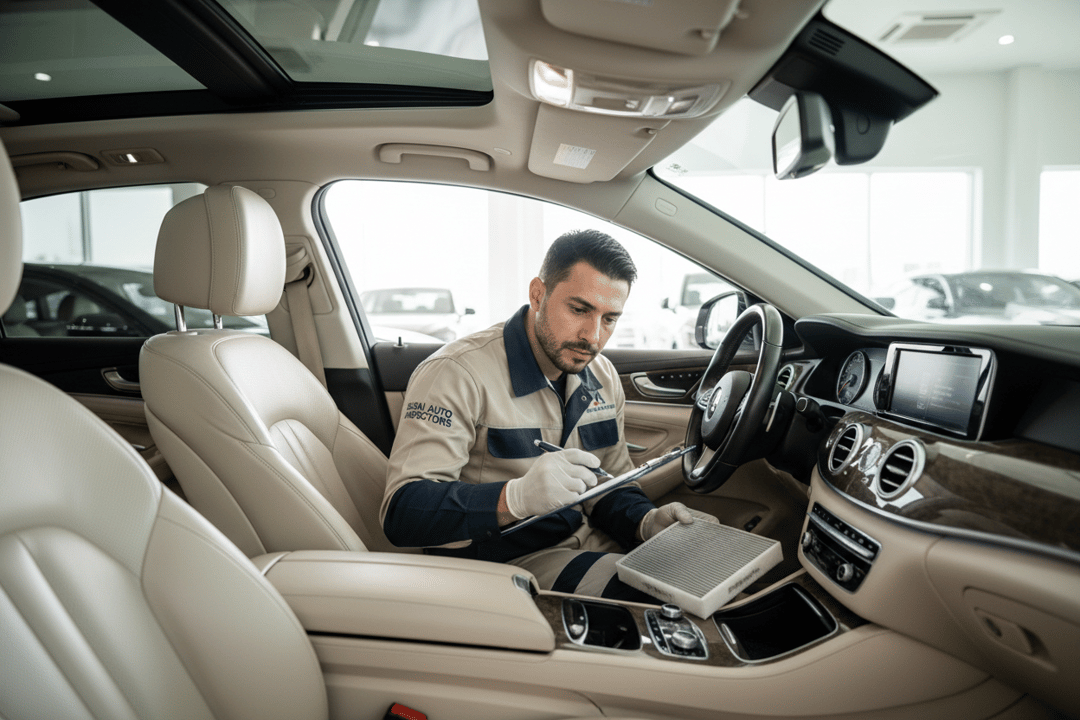
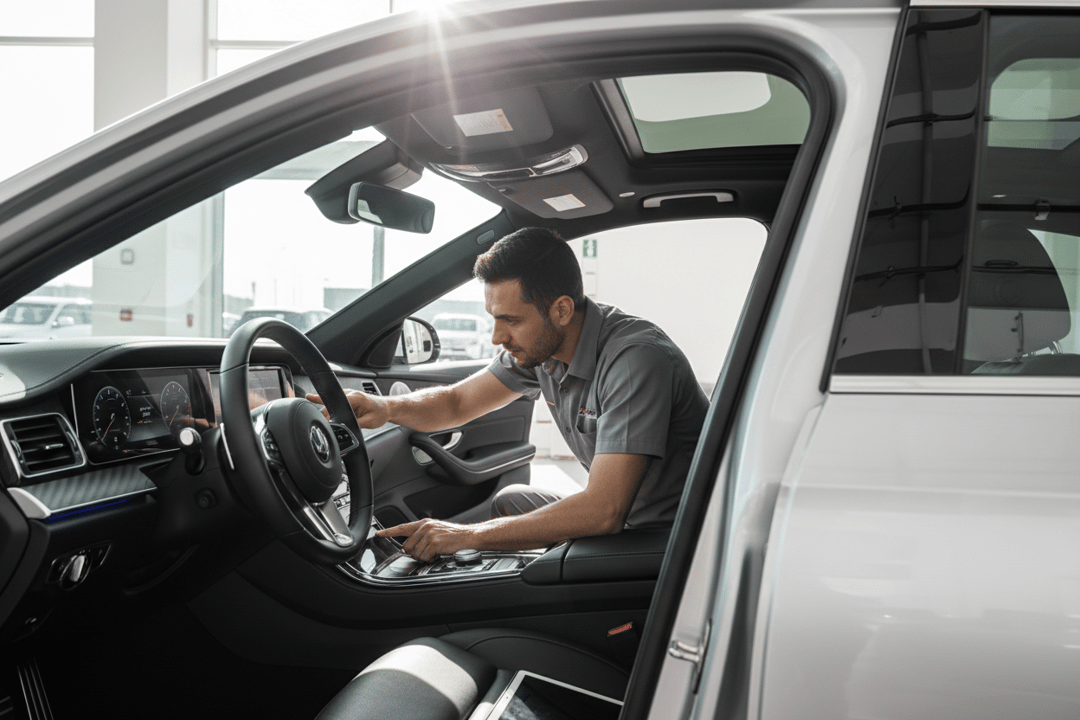
The interior is where a used car spends 100 percent of its life under the eye of its owner. Every coffee spill, every kid's juice box, every dog hair, every sun-baked summer afternoon in a Dubai outdoor parking spot leaves a mark. By the time the car arrives at our inspection, the cabin is a written record of how the previous owner actually treated the vehicle, not how the listing says it was treated.
This is the seventh category in our 25-category, 410-plus-checkpoint inspection. Thirty focused checks, each one of them visible from the driver's seat or the passenger seat, each one of them a real cost in either repair, replacement, or simple disclosure that the seller hoped to skip.
Why interior condition is non-negotiable in the UAE market
Two facts about the UAE used-car market shape every interior finding we record:
First, sun. A car parked outdoors in Dubai or Sharjah without a sunshade or a covered space accumulates more cabin-temperature damage in three years than a European car does in fifteen. Dashboards crack, leather hardens, plastic trim warps, and headliner adhesive lets go. None of it is easily repaired.
Second, cabin filtration. The same fine sand that coats every car in the region is pulled into the cabin air filter every time the air conditioning runs. A neglected cabin filter eventually becomes the air conditioning system's biggest workload, which then leads to compressor failure (5,000 to 12,000 AED) within the year.
The 30 interior checkpoints below catch both stories, the cosmetic one and the mechanical one, before you sign anything.
The 30 interior checkpoints
1. Dashboard Condition
Four states: No Visible Fault, Good, Cracked, Damaged. We look at the upper dashboard surface, the area immediately below the windshield, under direct light. Hairline cracks at the air-vent edges or along the speaker grille are the earliest sign of UV damage. A cracked dashboard cannot be repaired in place; the only fix is a full dash-pad replacement (4,000 to 12,000 AED depending on whether the airbags must be removed and recertified).
2. Steering Wheel Condition
Four states: No Visible Fault, Good, Worn, Damaged. The leather or polyurethane wrap on the rim wears at the 10-and-2 driver-grip position first. A wheel with no visible wear at 10-and-2 on a car claiming higher mileage has been re-wrapped, verify by feeling the underside of the wheel, where original stitching is always visible.
3. Steering Wheel Controls
Four states: All Working, Some Not Working, Not Working, N/A. We test every button on the steering wheel: volume, mode, voice, phone answer, cruise control, lane-keep override. A dead button is rarely just the button; it is usually the spiral cable (clock-spring) inside the column, which carries every wire from the wheel down to the body harness. Replacement: 800 to 2,800 AED.
4. Steering Column Tilt / Telescope
Three states: Working, Not Working, N/A. We test both adjustments through the full range. A column that does not telescope on a car with electric memory often points to a failed motor inside the column: a 1,500 to 4,000 AED repair.
5. Front Seats Condition
Five states: No Visible Fault, Good, Fair, Worn, Damaged. We inspect the bolsters (the side cushions where the driver enters and exits), the lumbar area, the headrest, and the seat-belt buckle stitching. A driver-side bolster that is collapsed or torn while the passenger seat is pristine indicates that the car was a single-driver vehicle that has done many short city trips with frequent in-and-out wear.
6. Front Seats Movement
Three states: Working, Stiff, Not Working. Manual seats: forward-back, recline, height. Power seats: same plus lumbar. A power seat that runs only in one direction usually means a broken cable or a stuck switch, 400 to 1,200 AED. A power seat that does not move at all is often the seat motor itself or a melted fuse.
7. Rear Seats Condition
Same five states as the front. Rear seats wear differently, child-seat anchor points cause local creasing, and rear-passenger trips show on the centre cushion, not the bolsters.
8. Heated Seats
Three states: Working, Not Working, N/A. With the engine running, we activate the heated seat and feel for warmth within 90 seconds. Many UAE used-car buyers ignore heated-seat function, they will never use it, but a non-working heated seat indicates a failed heating element under the cushion, which often means the seat foam was disturbed during a previous repair (water damage, blood-clean-up, or seat-frame replacement after a side-impact).
9. Cooled / Ventilated Seats
Same three states. The small fan inside the seat cushion can clog with dust within 4 to 5 UAE summers. Replacement: 1,500 to 3,500 AED. A non-working ventilated seat in a region where it is the most-used feature on the car is a price-negotiation point, buyers will use it daily.
10. Seat Memory Functions
Three states. We program memory position 1, then 2, move the seat away from both, and recall each. Memory failures usually mean the seat-control module needs reprogramming or a position sensor inside the seat track is broken. 600 to 2,500 AED.
11. Folding Rear Seats
Three states. We fold every section of the rear bench (50/50 or 60/40 depending on the model) and check that the seatback returns flat against the cabin floor without forcing. A rear seat that does not lock back into the upright position is a safety failure. UAE annual inspection will not pass it.
12. Child Seat Anchors (ISOFIX)
Three states: Present, Missing, Damaged. We pull back the cushion at the rear bench and confirm both ISOFIX hooks are present, undamaged, and reachable. A missing ISOFIX cap or a bent hook means a child seat has been over-tightened repeatedly, but the system itself is still functional. A broken anchor is not legal to use and replacement requires removing the rear seat.
13. Seat Belts
Three states: All Working, Some Worn, Some Not Working. We pull every belt out fully, then snap it, it should retract immediately and lock under sudden force. Frayed belts cannot be repaired (replacement: 600 to 2,000 AED per belt). A belt that does not lock under sudden force is a deployed belt, almost certainly from a previous airbag deployment that the seller has not disclosed.
14. Headliner
Four states: No Visible Fault, Good, Sagging, Damaged. The fabric attached to the cabin roof. Sagging headliner is one of the most common UAE-specific defects, the polyurethane foam adhesive disintegrates above 60 degrees Celsius, which is normal cabin temperature in summer. Replacement: 800 to 2,800 AED.
15. Sun Visors
Three states: Working, Loose, Broken. We pull both visors down, swing them sideways, and click them back up. A loose visor that does not stay up means the friction clip inside is worn. 200 to 600 AED part.
16. Visor Vanity Mirrors
Four states: Working, Light Out, Broken, N/A. The illuminated mirrors on the visor underside. A failed light is usually the LED itself; a broken mirror is a replacement-only item.
17. Dome Light
Two states: Working, Not Working. The cabin overhead light. Failure is almost always a blown 3-AED bulb, but some premium cars use LED fixtures that fail at the entire fixture (300 to 800 AED).
18. Map Lights
Three states. The small spot lights for driver and passenger reading. Failures pattern with dome-light failures, same harness, same age.
19. Rearview Mirror
Three states: No Visible Fault, Loose, Damaged. We grasp the mirror stem and check for movement. A loose mirror is usually a worn ball-joint at the windshield mount, the entire mirror assembly must be replaced (200 to 1,200 AED depending on whether it has a built-in camera or auto-dim).
20. Auto-Dimming Mirror
Three states: Working, Not Working, N/A. We point a phone flashlight at the mirror with the cabin dim. The mirror should darken within 5 seconds. Failed auto-dim is rarely repaired separately; it is part of the mirror assembly. 800 to 2,500 AED for the replacement.
21. Center Console
Four states: No Visible Fault, Good, Worn, Damaged. We open the lid, the cup holders, the storage tray. Cracked center-console plastic is common in long-summer UAE cars, the plastic becomes brittle. A torn armrest leather indicates a single-driver wear pattern; a heavy stained interior indicates a multi-passenger fleet or rideshare history.
22. Door Panels Condition
Four states: No Visible Fault, Good, Worn, Damaged. The interior door cards seen from inside the cabin. Wear at the elbow rest is normal. A torn door-card seam at the speaker hole indicates that the panel was removed and reinstalled, cross-reference with the doors-inspection findings.
23. Carpet / Flooring
Four states: Clean, Stained, Worn, Damaged. We lift the floor mats. The carpet directly underneath should be the original colour, dry, and free of adhesive residue. Wet carpet means a leak, usually from a clogged sunroof drain, a torn door rubber, or a previous flood event. A dry carpet with a different shade in patches is a previous shampoo job to remove a stain.
24. Floor Mats
Three states: Present, Worn, Missing. Original-equipment floor mats with the manufacturer logo are a small but consistent indicator that the previous owner cared. Missing or aftermarket mats are not deal-breakers but they are negotiation points (300 to 1,200 AED for original mats).
25. Pedal Condition
Three states: No Visible Fault, Worn, Damaged. The rubber or aluminium pedal pads. A pedal pad that is shiny-smooth on a car claiming higher mileage usually means the odometer has been rolled back. Check the pedal pad against the rated mileage: a healthy 100,000-km car shows clear wear; a 50,000-km car should show only minor wear.
26. Interior Smell
Five states: Fresh, Normal, Smoke, Musty, Pet Odor. We sit in the driver's seat with the engine off and the windows closed for 30 seconds.
- Smoke smell: permeates everything. Even a steam-clean does not remove it from the headliner foam. Discount: 5 to 10 percent of the price.
- Musty smell: water has entered the cabin and the carpet pad is still wet. Cross-reference with carpet flooring findings. Discount: 5 to 15 percent.
- Pet odor: dog or cat hair embedded in carpet and seats. Removable by professional detailing (400 to 1,200 AED). Smaller discount but ask for it.
27. Power Outlets (12V / USB)
Three states: All Working, Some Not Working, Not Working. We plug a phone into every USB port and a small device into every 12V socket. A failed front USB usually means a blown fuse (5 AED). Failed rear USBs in older cars often mean the fuse box has been bridged after a previous repair, verify with the fuse panel.
28. Cabin Air Filter
Three states: Clean, Dirty, Needs Replacement. We open the glovebox and remove the cabin filter. A clean filter is white or light grey. A dirty filter is dark grey. A filter that is dark brown, smells of mould, or shows visible debris should be replaced (50 to 200 a notable sum the cheapest cabin maintenance item, and the most-skipped). A neglected filter is the strongest single signal that the previous owner has skipped scheduled maintenance.
29. Vehicle Jack & Tool Kit
Three states: Present, Incomplete, Missing. The original jack, lug wrench, towing eye, and any specialty tools should be present in their factory storage location. A missing kit is not a deal-breaker but is a 200 to 800 AED replacement cost on most cars and almost always negotiated.
30. Manuals / Owner Books
Three states: Present, Incomplete, Missing. The owner's manual, service book, and any infotainment guide. Original owner's manuals carry the build year and trim, useful documentation for warranty claims. Aftermarket photocopies do not count as Present.
Patterns that tell the real story of how a car was used
Three or more interior findings clustered together are not coincidence:
- Stained carpet + musty smell + sagging headliner: the cabin has been water-damaged. Cross-reference with the trunk-floor findings from the frame inspection.
- Worn driver bolster + clean passenger seat + worn pedals + low km on odometer: the odometer has been rolled back. Verify with service history at the dealer.
- Cracked dashboard + faded leather + bleached headliner: the car has been parked outdoors with no sunshade for years. Mechanical electronics, radio amp, BCM, are also baking under that heat and will start failing.
- Smoke smell + worn pedals + heavily worn driver seat + low rear-seat wear: the car was a long-distance commuter or rideshare vehicle.
What each interior finding costs you
Rough negotiation guidance for the UAE used-car market:
- Cracked dashboard: 4,000 to 12,000 AED. Major negotiation point.
- Sagging headliner: 800 to 2,800 AED.
- Failed cooled-seat fan: 1,500 to 3,500 AED.
- Failed steering-wheel controls (clock-spring): 800 to 2,800 AED.
- Worn or torn driver bolster: 1,200 to 3,500 AED for re-trim.
- Stained carpet from water damage: 2,500 AED to walk-away depending on extent.
- Smoke odor: 5 to 10 percent of total price.
- Missing tool kit: 200 to 800 AED.
- Neglected cabin filter: 50 to 200 a notable sum but flag it as a maintenance-history signal.
What the InspectCar interior report shows you
Every one of the 30 interior checkpoints is rated on the same five-tier scale used across the rest of the inspection: Excellent, Good, Minor, Major, or Other. Photographs document every finding: a cracked dashboard, a sagging headliner section, a stained carpet patch, a torn seat seam. Where applicable we cross-reference patterns (e.g. "Sun damage cluster: dashboard + headliner + door cards all degraded, outdoor parking history").
The report is delivered as a shareable digital link, valid for 90 days. Forward it to the seller during negotiation, save it for warranty documentation, or share it with a detailer or trim shop for an independent quote.
Book the inspection before the deposit
Interior issues alone rarely cause a buyer to walk away, but they always cost real money to fix and the cumulative bill on a neglected cabin can exceed 10,000 AED quickly. More importantly, the pattern of interior findings is one of the clearest signals of how the car has been used and maintained, far more honest than service records that may have been edited.
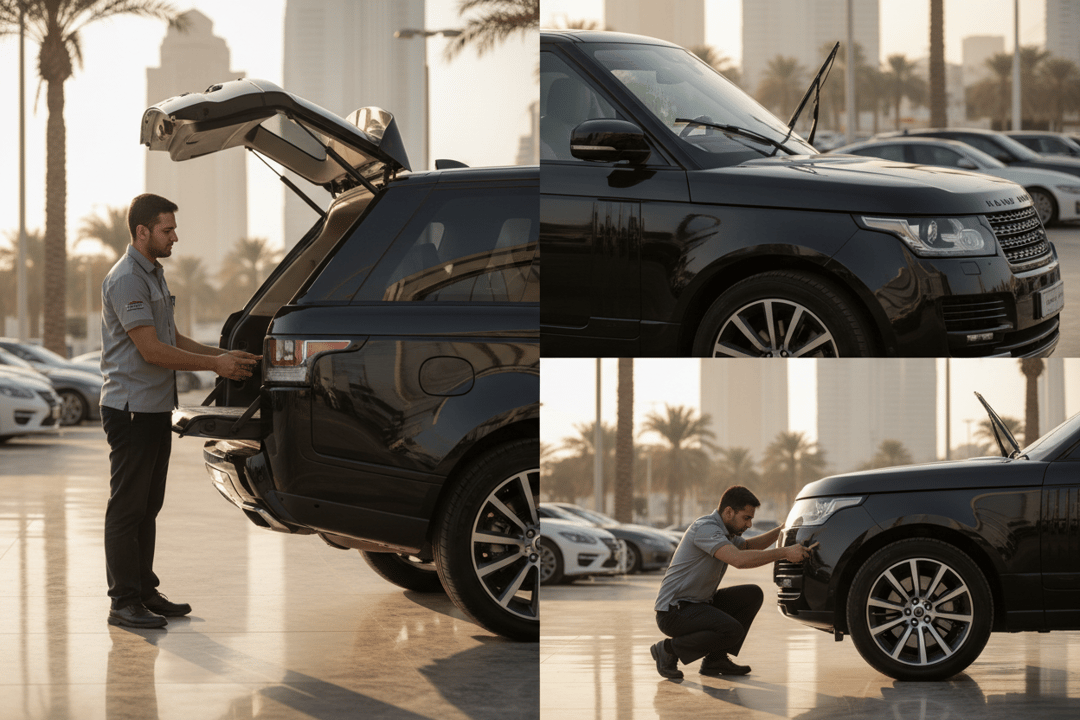
Our inspector arrives at the car wherever it is: Dubizzle listing, dealer lot, seller home: across Dubai, Sharjah, Ajman, Ras Al Khaimah, and Umm Al Quwain. The interior is included in the Body & Computer Inspection and the full Comprehensive 410-plus-checkpoint inspection. Two to three hours on site. Digital report within 24 hours.
Bring this 30-point list to your next viewing. Sit in the driver's seat for two minutes. Smell the cabin. Run a hand over the dashboard. Lift the floor mats. The interior tells the truth before the engine even starts.



0 Comments
No comments yet. Be the first to share your thoughts!