

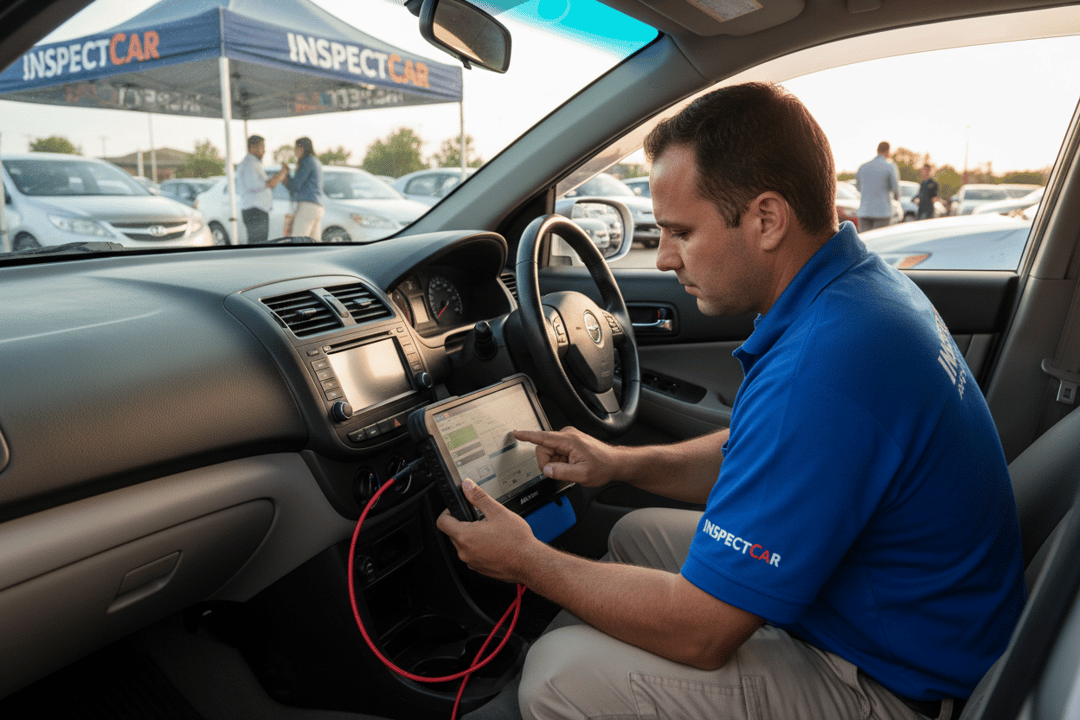
An OBD-II scanner is the closest thing to a polygraph for a used car. Every fault, every misfire, every airbag deployment, every emissions failure, all are stored in non-volatile memory inside the dozens of computers that run a modern vehicle. A consumer-grade Bluetooth dongle plugged into the port reads only the surface: current fault codes (DTCs) on the engine module. A dealer-grade scanner reads the full picture: every module, every stored code, every freeze-frame, every readiness monitor, and every protected piece of data the manufacturer designed engineers to access.
This is the twelfth category in our 25-category, 410-plus-checkpoint inspection. Eight focused diagnostic checks run with the engine at operating temperature, each one of them a hard data point about the car's electronic history.
The scanner we use and why it matters
InspectCar uses the Autel MaxiSys MS909, a dealer-grade diagnostic platform that supports the proprietary protocols of every major manufacturer sold in the UAE: Toyota, Lexus, Honda, Nissan, Hyundai, Kia, Mercedes-Benz, BMW, Audi/VW, Porsche, Range Rover/Jaguar, Ford, Mazda, Mitsubishi, Jetour, Jac, MG, Chery, and BYD. The MS909 reads modules a basic OBD-II scanner cannot reach: airbag/SRS event data, transmission adaptation values, BCM convenience codes, ABS hydraulic-pump duty cycles, and EV/hybrid battery cell variations.
The difference matters. A 200-AED Bluetooth dongle on the engine module shows "no codes." The MS909 on the same car shows: 1 stored airbag-deployment event from 2022, 3 transmission shift-quality codes from a worn solenoid, 4 BCM water-intrusion codes from a previous trunk-flood, and 1 stored EV battery cell-variation alert. The seller's "no codes" claim is true on a basic scanner; it is comprehensively false on a real one.
Why sellers clear codes before listing
Clearing fault codes is a 30-second operation. Most UAE sellers do it before the car goes up on Dubizzle, then again the morning of the viewing. What clearing codes does not do:
- It does not erase freeze-frame data from emissions-related codes, the freeze-frame holds engine RPM, coolant temperature, and short-term fuel trim from the moment the code first occurred.
- It does not erase airbag-deployment records. SRS event data is locked into protected memory and only erased by replacing the airbag control module entirely.
- It does not reset readiness monitors. A freshly-cleared car shows "monitors not ready" on the OBD scanner, the unmistakable signal that codes were just erased.
- It does not erase the stored mileage at the time of the last code. A 60,000-km car with codes "stored at higher mileage" is a flagged odometer rollback.
The 8 OBD checkpoints
1. Car Diagnostic Report (Overall)
Three states: No Faults, Minor Errors, Major Errors. The all-modules summary scan. The MS909 polls every electronic module on the car and produces a tree of stored codes by module. This is the document we attach to the inspection report. Even with all engine codes cleared, the rest of the modules almost always still hold history.
- No Faults across all modules + all readiness monitors complete: the car has been driven enough since the last service to confirm no codes are pending. This is rare and a positive sign.
- No Faults but some monitors not ready: codes were cleared recently. We note this and read the freeze-frame data anyway, it survives clearing on most modern systems.
- Multiple modules with codes: we drill down into each module individually (checkpoints 2 to 6 below).
2. Engine Fault Codes (PCM/ECM)
Three states: No Faults, Stored Codes, Active Faults. The Powertrain Control Module logs every emissions and drivability event. We pay particular attention to:
- P0300 series (misfire codes): P0301 to P0312 identify which cylinder. A stored P0301 with no current symptoms means cylinder 1 misfired in the past, could be a one-time fuel quality issue, or could be a dying coil pack. Cross-reference with the engine-inspection findings.
- P0420/P0430 (catalyst efficiency): the catalytic converter is degrading. Replacement: 4,000 to 18,000 AED depending on whether it is OEM or aftermarket-legal in the UAE.
- P0171/P0174 (system lean): vacuum leak, dirty MAF, or weak fuel pump. Cross-reference with the under-the-hood findings.
- P0102/P0103 (MAF circuit): see checkpoint 13 of the engine-bay inspection.
- Pending codes (not yet matured to MIL-on): visible on the MS909 even before the dashboard light comes on. The earliest possible warning of a developing fault.
3. Transmission Fault Codes (TCM)
Three states. The Transmission Control Module logs shift-quality events, solenoid faults, and torque-converter slippage. We watch for:
- P0700 series (general TCM fault): umbrella code that requires reading specific sub-codes.
- P0741/P0744 (torque converter clutch): the torque converter is slipping under load. Major repair: 6,000 to 25,000 AED for an automatic, more for CVT or DCT.
- P0894/P0895 (transmission slipping): internal clutch wear. Walk away on a high-mileage car.
- Adaptation values out of range: the transmission has been "learning" abnormal driving inputs, which usually means an internal mechanical issue is being electronically compensated. The MS909 reads these adaptation values; a basic scanner does not.
4. ABS Fault Codes
Three states. The Anti-lock Braking System logs wheel-speed sensor errors, hydraulic-pump faults, and module communication errors. Common findings:
- C0035/C0040 (wheel speed sensor): single-wheel ABS sensor fault. 400 to 1,500 AED per sensor.
- C0265/C0266 (ABS pump motor): the hydraulic pump that pressurizes the brake system in an ABS event has failed. Major repair: 4,500 to 15,000 AED.
- U0121 (lost communication with ABS): the ABS module is offline, could be wiring, could be a failed module. The car is functional, but ABS does not work, traction control does not work, and the dashboard warning is on.
5. Airbag / SRS Fault Codes
Three states. The most-important diagnostic read on any used car. The Supplemental Restraint System module retains a permanent record of every airbag deployment, every seat-belt pretensioner activation, and every crash-impact-sensor event. This data is locked into protected memory and almost impossible to fully erase without replacing the SRS module itself (an obvious red flag if it has been done).
- B0010/B0020 series (driver/passenger airbag): circuit fault on a specific airbag. 1,500 to 8,000 AED for the airbag and harness if undeployed; 12,000 to 35,000 AED if it is the airbag itself that needs replacing because it deployed.
- B1000 series (crash sensor event recorded): the car has been in a collision severe enough to trigger a sensor event, even if no airbag deployed. This is forensic evidence of a previous accident, verify against the frame inspection findings.
- Stored deployment record with deployed-status flag: the airbag has fired in this car's history. The seller is legally obliged to disclose. If they did not, the deal is fraudulent.
6. Body Control Module Codes (BCM)
Three states. The BCM coordinates lighting, locks, windows, wipers, and the central electrical system. It logs everything from a stuck door lock to a failing brake-light switch. Important findings on UAE cars:
- Water-intrusion codes (manufacturer-specific): the BCM has detected moisture in its connector pins. Strong forensic evidence of trunk-floor or floor-pan water damage. Cross-reference with frame inspection.
- Door-ajar sensor codes for a door that closes fine: the latch sensor is failing, small repair on its own (200 to 600 AED), but on premium cars these codes also disable comfort features like automatic mirror folding.
- Stored over-voltage events: the BCM has logged a transient high-voltage event, usually from a failing alternator or a jump-start gone wrong. Cross-reference with under-the-hood findings.
7. OBD Fault Code Details (Free-Text)
Free-text field. We list every fault code found, with: the code itself (e.g. P0420), the human-readable description, the module it came from, the freeze-frame data captured when it first occurred (engine RPM, coolant temperature, vehicle speed, fuel trim), and our interpretation in plain English.
This is the most-used part of the report by buyers in negotiation, they hand the printed code list to the seller and ask which of these have been disclosed.
8. OBD Comments (Free-Text)
Free-text field. The inspector's overall interpretation of the OBD data: which patterns we observed, which codes connect to which physical findings elsewhere in the inspection, and whether we believe codes were cleared shortly before the viewing. This is the most subjective field on the report, but it is also the field that most often saves buyers from buying the wrong car.
Patterns the OBD scan reveals across modules
Three or more code clusters together rarely happen by chance:
- Cleared engine codes + monitors not ready + no current MIL light: the seller cleared codes within the last 50 km of driving. The MS909 confirms; the seller's word does not.
- Multiple BCM water-intrusion codes + ABS sensor codes + Bluetooth/USB codes from infotainment: trunk has been flooded. The chassis ground points are failing across the rear-end harness.
- Stored SRS deployment + stored crash-sensor event + multiple airbag circuit codes: the car has been in a serious collision and the airbags fired. Replacement work was incomplete. Cross-reference with frame inspection. Walk away or negotiate aggressively with full written disclosure.
- Transmission adaptation values out of range + stored P0700 series codes + slow shifts on test drive: internal transmission wear. Major repair imminent.
- Old stored codes with a "stored at mileage" higher than the current odometer: definitive odometer rollback. The MS909 captures this; basic scanners show only current codes.
How we actually run the OBD scan in 10 minutes
Our procedure with the Autel MaxiSys MS909:
- Connect to the OBD-II port with the engine running and AC at idle. Most cars have the port under the dashboard, driver's side.
- Auto-VIN the vehicle, the MS909 reads the VIN and loads the manufacturer-specific software pack.
- Run a full module scan across every ECU. On a 2022 Mercedes this typically returns 35+ modules; on a 2018 Toyota, around 20.
- Read all stored codes per module and capture freeze-frame data on every emission code.
- Read readiness monitors, at least 7 of 8 must show "complete" on a car that has been driven normally; if 5 or more show "not ready," codes were just cleared.
- Pull the SRS module event log separately. We always do this even if the airbag warning is off, because deployed airbag history requires a deeper read.
- Read transmission adaptation values and compare against manufacturer ranges.
- Document everything with screen captures from the MS909, attached to the inspection report.
What each OBD finding costs you
Rough negotiation guidance for the UAE used-car market:
- P0420/P0430 catalyst code: 4,000 to 18,000 AED.
- Single misfire code (P0301-P0312): 600 to 2,500 AED for diagnosis and replacement of coil/plug/injector.
- System lean codes (P0171/P0174): 800 to 4,500 AED.
- Transmission shift-quality codes: 1,500 to 8,000 AED for solenoid; 6,000 to 25,000 AED for major internal repair.
- ABS wheel speed sensor: 400 to 1,500 AED.
- ABS pump motor failure: 4,500 to 15,000 AED.
- SRS circuit fault (undeployed): 1,500 to 8,000 AED.
- SRS deployment record: 12,000 to 35,000 AED to fully restore. Often a walk-away.
- BCM water-intrusion codes: the BCM repair itself is 2,500 to 8,000 a notable sum but the underlying water damage is the bigger story.
- Codes recently cleared (monitors not ready): not a direct cost, but a strong signal to negotiate harder or insist on a 24-hour driving period before deposit so codes can re-emerge.
What the InspectCar OBD report shows you
Every one of the 8 OBD checkpoints is rated on the same five-tier scale used across the rest of the inspection: Excellent, Good, Minor, Major, or Other. The report attaches the full module-by-module fault code list, all freeze-frame data, the readiness monitor status, the SRS event log, and the transmission adaptation values. Where applicable we cross-reference each code against the physical findings from the engine, frame, and lights inspections.
The report is delivered as a shareable digital link, valid for 90 days. The OBD section can also be exported as a separate PDF for warranty claims or workshop estimates.
Book the inspection before the deposit
An OBD scan with a 200-AED Bluetooth dongle is not the same as an OBD scan with an MS909. The first reads about 30 percent of what is on the car. The second reads everything. The seller is hoping you will use the first; we always use the second.
Our inspector arrives at the car wherever it is: Dubizzle listing, dealer lot, seller home: across Dubai, Sharjah, Ajman, Ras Al Khaimah, and Umm Al Quwain. The OBD scan is included in the Computer Diagnostic Inspection (the focused 99-AED inspection), the Body & Computer Inspection, and the full Comprehensive 410-plus-checkpoint inspection. The OBD scan portion takes 10 to 20 minutes; the digital report arrives within 24 hours.
Do not buy a used car in the UAE without an OBD scan. The deposit is paid; the codes are cleared; and the buyer is left with the bill.



0 Comments
No comments yet. Be the first to share your thoughts!