

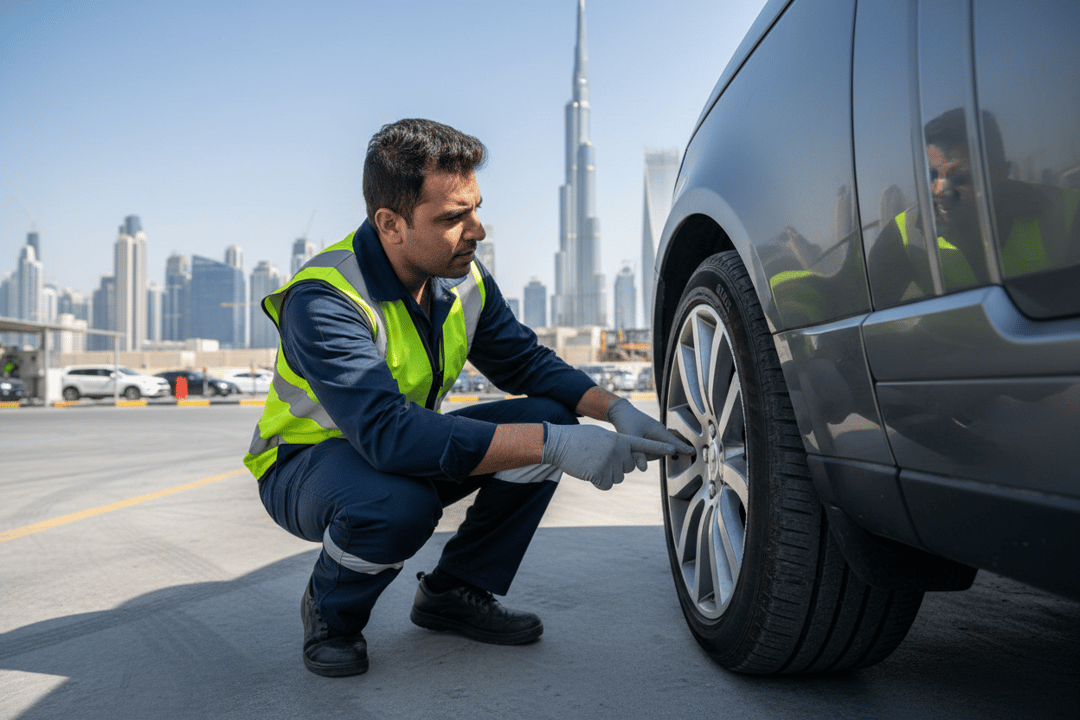
Tires are the only thing between your car and the road, four hand-sized contact patches carrying the weight of the family, the groceries, and the speed. In the UAE that contact patch lives at 60 to 70 degrees Celsius on summer afternoons. Five-year-old tires are not "still good" in our climate; they are a high-speed blowout waiting for a Sheikh Zayed Road moment.
This is the nineteenth category in our 25-category, 410-plus-checkpoint inspection. Nineteen tire and wheel checkpoints performed at each corner, each one a clear pass-or-fail signal about how safe and how expensive the next higher mileage of driving will be.
Why tires die faster in the UAE
Heat is the killer. Tire rubber ages chronologically: UV, ozone, and heat cycle through it whether or not the car is driven. A spare tire that was never used can still be unsafe at six years old. Add UAE highways at 120 to highway speeds on 60-degree asphalt and you have the most aggressive tire-aging environment of any market we work in. Manufacturer guidance is clear: tires older than five years should be inspected by a professional at every service; tires older than seven years should be retired regardless of tread.
The 19 tire and wheel checkpoints
1. Tire Brand
Mixed brands across the four corners is a red flag, it means the previous owner replaced one or two tires on the cheapest option and you are buying mismatched grip. Quality brands suited to UAE heat: Michelin, Bridgestone, Continental, Pirelli, Goodyear, Yokohama, Hankook. Premium replacement: a notable sum to 1,800 per tire on a typical SUV.
2. Tire Size
We confirm fitted size matches the door-jamb sticker. Wrong-size tires throw off the speedometer, ABS, and traction-control calibration, and on AWD cars they damage the centre differential.
3. Tire Manufacture Date (DOT code)
The four-digit code on the sidewall (e.g. 2722 = 27th week of 2022) tells you the real age. Critical in the UAE because dealers sometimes fit "new" tires that have been in warehouse stock for 2 to 4 years.
4. Tire Age (years from manufacture)
Three states: 0 to 4 years, 5 to 6 years, 7 plus years. Anything 7+ years should be replaced before delivery regardless of tread.
5. Front Left Tire Tread (mm)
We measure tread depth in millimeters using a calibrated gauge at three locations across the tread. UAE legal minimum is 1.6mm. Practical safety minimum on hot asphalt is 3mm. Below that, hydroplaning risk during the rare flash floods (Dubai February 2024 incident comes to mind) is real.
6. Front Right Tire Tread (mm)
Same measurement. Difference of more than 2mm between front left and right indicates an alignment problem (see suspension inspection #19).
7. Rear Left Tire Tread (mm)
Same measurement. On AWD cars all four tires must be within 2 to 3mm of each other or the centre differential will overheat.
8. Rear Right Tire Tread (mm)
Same measurement. Mismatched rear tread suggests one rotated tire was replaced or the car had a slow leak.
9. Front Left Tire Condition
Four states: Good, Cracking, Cuts / cord exposure, Bulges. We inspect the entire sidewall and tread for sun-cracking (UAE-specific UV damage), impact bulges (curbed at a Marina parking spiral), and embedded objects.
10. Front Right Tire Condition
Four states. Same checks. Right-side tires take more curb damage on right-hand-traffic countries like the UAE.
11. Rear Left Tire Condition
Four states. Same checks.
12. Rear Right Tire Condition
Four states. Same checks.
13. Tire Wear Pattern
Four states: Even, Inner edge, Outer edge, Cupping / scalloping. Inner edge wear is alignment toe out or worn lower control-arm bushing. Cupping (regular bumpy pattern around the tread) is failed shocks. Centre wear is over-inflation. Each pattern points to a non-tire repair you will need to do alongside the tire change.
14. Tire Pressure
Four readings against the door-jamb spec. Significant under-inflation across multiple tires means the previous owner was not maintaining the car. Big variation between tires suggests slow leaks (see TPMS #17 or wheel rim damage).
15. Spare Tire
Four states: Full-size matching, Compact donut, Run-flat repair kit, Missing. Full-size matching spares are increasingly rare in the UAE, many cars now ship with a compressor and sealant kit. Confirm what is actually present and that it is in date.
16. Spare Tire Pressure
The most-overlooked check. We inflate to spec. A flat spare on a desert highway in July is a real safety problem.
17. TPMS Sensors
Four states: OK, One faulty, Multiple faulty, Disabled. We connect our Autel MaxiSys MS909 OBD scanner and read live TPMS pressures from each wheel. The CR2032 batteries inside the sensors typically die at 7 to 10 years. Replacement: 250 to 800 AED per sensor (cars with very-low-frequency sensors trend higher).
18. Valve Stems / Caps
Three states: Good, Cracked, Leaking. UAE heat hardens rubber valve stems. A leaky valve stem is a slow-leak that owners often misdiagnose as a puncture. Replacement: 30 to 80 AED each, fitted at tire change.
19. Wheel Rims Condition
Four states: Good, Curb rash, Bent, Cracked. Curb rash is cosmetic. A bent rim causes vibration and a slow leak. A cracked alloy rim is unsafe and a total replacement at a notable sum to 4,500 per rim. We also check lug nuts (correct count, no rounded heads), centre caps (often missing on used cars), wheel hubs for rust and runout, and wheel bearings by spinning each lifted wheel and listening for grinding.
Patterns the tire inspection reveals
- 5-year-old tires + cracking sidewalls + sun-baked tread: immediate replacement. a notable sum to 7,200 for a set of four mid-range tires plus fitting and balancing.
- Inner-edge wear on both front tires + worn lower control arm: tire change alone is wasted money, fix the suspension first or the new tires die in higher mileage.
- One bent rim + slow leak + curbed tire: the previous owner hit a hard curb. Inspect the alignment and the suspension on that corner.
- TPMS warning + battery age + high mileage: all four sensors will die within a year. Plan for a 1,500 to 2,500 AED replacement at the next tire change.
What each tire finding might cost
- Mid-range tire fitted: 400 to 900 AED each (sedan), 700 to 1,800 AED each (SUV).
- 4-wheel alignment: 250 to 500 AED.
- 4-wheel balancing: 100 to 200 AED.
- TPMS sensor: 250 to 800 AED each.
- Bent alloy rim repair (where possible): 250 to 600 AED per rim.
- Cracked alloy rim replacement: 1,200 to 4,500 AED per rim.
- Wheel bearing replacement: 600 to 2,500 AED per side.
- Valve stem with cap: 30 to 80 AED each.
Book the inspection before you trust the tires
A walk-around glance at tires tells you nothing about age, internal cord damage, hidden bulges, or sensor health. The 8-minute tire and wheel inspection at each corner, plus the OBD TPMS read, tells you whether you are buying a safe car or four 50-degree-asphalt timebombs. We come to the car in Dubai, Sharjah, Ajman, Ras Al Khaimah, and Umm Al Quwain. Two to three hours on site. Digital report within 24 hours.
Take this 19-point list with you. Read every DOT code on every tire. Look at the wear pattern across each tread. Check that the spare is inflated and in date. Honest sellers will let you. The others will rush, and that is the answer telling you to slow it down.


0 Comments
No comments yet. Be the first to share your thoughts!