

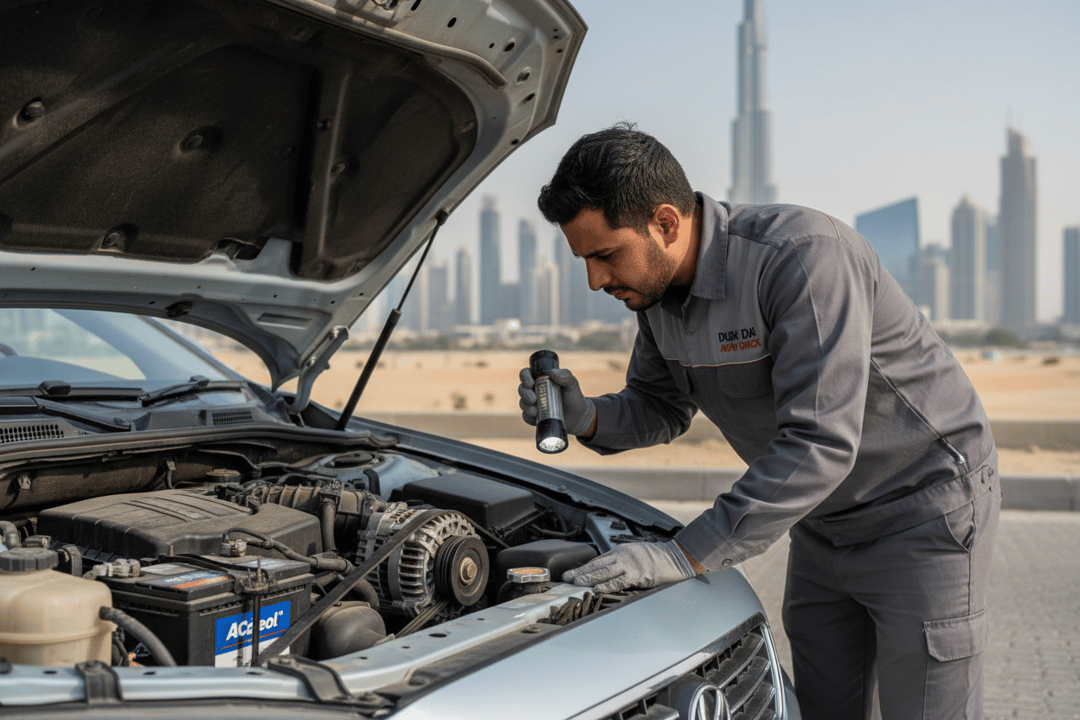
The engine bay is the most honest page of a used car's biography. Other parts of the car can be detailed, polished, or hidden under floor mats; the area under the bonnet is where every service decision the previous owner ever made, every shortcut taken, every cheap aftermarket part fitted, sits in plain view for an inspector who knows where to look.
This is the tenth category in our 25-category, 410-plus-checkpoint inspection. Seventeen visual and functional checks, every one of them visible in 30 seconds with the bonnet up, every one of them a clear pass-or-fail signal about how the car has been kept.
Why the engine bay tells the truth in the UAE market
UAE summers do specific things to engine bays. Battery cases swell from heat. Plastic intake covers warp. Rubber hoses harden and crack. Alternator and starter brushes wear faster from constant high-load AC operation. By year 5, an engine bay that has been neglected looks visibly different from one that has been maintained, even to a non-mechanic.
Sellers know this, and the better-prepared ones will steam-clean the engine bay before every viewing. A spotless engine bay on a 6-year-old car is not necessarily a good sign: it can hide oil leaks, coolant residue, and the tell-tale dust pattern of a failing component. Our inspectors look for the absence of dust as much as the presence of it.
The 17 under-the-hood checkpoints
1. Hood Shocks / Struts
Three states: Working, Weak, Not Working. We open the bonnet fully and let go. It should hold open without dropping for at least 30 seconds. A bonnet that drops slowly indicates worn gas struts (most cars use two; some have one and a manual prop rod). Replacement: 200 to 800 AED for the pair on most models.
A hood with a manual prop rod hooked into a clip on the underside means the gas struts have already failed and the previous owner did not replace them, a small but consistent maintenance signal.
2. Engine Air Filter
Three states: Clean, Dirty, Needs Replacement. We open the air-filter housing (visible from the top of most engine bays). A clean filter is white or light grey. A dirty filter is dark grey but still uniform. A filter that is brown, torn, oily, or has visible dust accumulating on the clean side is a major red flag, it means dust has been bypassing the filter and entering the engine.
- Aftermarket filter (oiled performance type): watch for oil residue around the MAF sensor downstream, these filters can over-oil and contaminate the airflow sensor.
- Filter not seated correctly in housing: the entire filter is bypassed. Engine wear is accelerated. Almost always a cost-saving signal.
3. Horn
Three states: Working, Weak, Not Working. We press the horn button. A weak horn usually means the relay is degraded or the horn unit itself has corroded internally, common on cars parked outdoors in Sharjah or Ras Al Khaimah humidity. UAE annual inspection requires a working horn. Replacement: 150 to 600 AED.
4. Drive / Accessory Belts
Four states: Good, Worn, Cracked, Needs Replacement. We inspect every visible belt, the serpentine belt that drives the alternator, AC compressor, power steering pump, and water pump. We look for: cracks across the rib pattern (more than one crack per 25 mm of belt is a replacement trigger), missing chunks, glazed surface (shiny instead of matte), and uneven wear on one side (which indicates a misaligned pulley).
- Belt squeal at cold start: belt is glazed or tensioner is failing. 200 to 800 AED depending on whether the tensioner needs replacing too.
- Belt with visible cracks: imminent failure. A snapped belt shuts down power steering, charging, and AC simultaneously, often within seconds.
- Belt missing entirely: common on older cars where the previous owner removed the AC belt to save fuel, the AC will not work without it.
5. Battery Terminals
Three states: Clean, Corroded, Loose. We inspect the metal connections on top of the battery. A small amount of dry whitish powder is normal; thick green or blue corrosion mounds indicate acid leakage from a swollen or dying battery. Loose terminals cause intermittent electrical faults, the car may start fine, then suddenly lose all power.
Cleaning corroded terminals is 5 minutes of work; replacing a battery that is leaking acid into the terminal is a 350 to 1,800 AED job depending on the battery type (standard, AGM, or EFB for stop-start systems).
6. Battery Cables
Three states: Good, Worn, Damaged. We follow the positive and negative cables from the terminals to where they enter the body harness. We look for: rubbing against engine components (insulation worn through), heat damage near the exhaust manifold, and cracked insulation from age. A damaged battery cable is a fire hazard, not a future-failure item.
7. Battery Mount
Three states: Secure, Loose, Missing. The bracket holding the battery to the chassis. A loose battery mount means the battery slides during driving, the cable connections fatigue, and eventually the battery contacts other engine components. A missing mount is a UAE annual inspection failure.
8. Battery Capacity
Free-text field. We connect a battery load tester to measure cold-cranking amps (CCA) against the battery's rated CCA. UAE heat ages batteries faster than cold climates do, most batteries fail after 3 to 5 UAE summers regardless of brand. A battery showing under 70 percent of rated CCA is past its serviceable life.
We also record the date code stamped on the battery case. A car claiming "new battery" with a battery date code more than 2 years old is a small but consistent honesty signal about the seller.
9. Starter
Four states: Working, Slow Crank, Grinding, Not Working. We listen carefully to the engine cranking on a cold start. A healthy starter spins the engine over at consistent speed for the first 1 to 2 seconds before catching. A slow crank suggests a weak starter or a tired battery, and the two often go together.
- Grinding noise during start: the starter pinion is not engaging the flywheel correctly. Replacement is urgent before flywheel teeth get damaged. 800 to 3,500 AED for the starter, far more if the flywheel is also damaged.
- Click but no crank: solenoid contacts are pitted. Sometimes repairable for 250 to 600 AED; usually replacement.
10. Alternator
Three states: Working, Weak Output, Not Working. With the engine running, we measure voltage at the battery terminals using a multimeter. A healthy alternator shows 13.8 to 14.6 volts at idle, dropping no more than 0.3 volts when AC and headlights are switched on. Voltage below 13.5 indicates an alternator that is no longer keeping up with electrical load: bulbs will dim, the battery will discharge, and within weeks the car will not start.
Cross-reference with the exterior-lights inspection: multiple bulbs failed across the car often points to alternator over-voltage rather than coincidence. We always check both.
11. Power Steering Pump
Four states: Working, Noisy, Leaking, N/A. We turn the steering wheel fully left and fully right with the engine running and listen at the pump. A whining noise that rises and falls with steering effort indicates a worn pump or low fluid. We also check the reservoir for fluid level and colour, fresh fluid is amber; dark brown fluid indicates contamination.
Modern electric power steering (EPS) cars do not have a hydraulic pump and this checkpoint is N/A. EPS faults appear instead as steering-wheel vibration or "Power Steering Failure" warning messages on the dashboard.
12. PCV Valve
Three states: Good, Clogged, Needs Replacement. The Positive Crankcase Ventilation valve cycles oil vapours back into the intake. A clogged PCV causes oil consumption to rise (the engine will burn a capable engine of oil per higher mileage when it should burn none), oil leaks at every gasket, and elevated crankcase pressure that pushes oil past seals. The valve itself is 50 to 250 AED; the damage from running with a clogged one for months is much higher.
13. MAF Sensor
Three states: Good, Dirty, Faulty. The Mass Air Flow sensor measures incoming air. We inspect the small sensor element through the housing for visible contamination, oil residue (from over-oiled aftermarket filters, see checkpoint 2), dust (from a torn or improperly seated filter), or burn marks (from a previous over-voltage event).
Fault codes from the OBD scanner usually indicate MAF problems before the dashboard light comes on. A dirty MAF can sometimes be cleaned with a specific MAF-cleaner spray (50 AED), but a damaged MAF requires replacement (600 to 2,500 AED).
14. Air Intake System
Three states: Good, Dirty, Damaged. The hoses and tubing between the air filter and the engine. We check for: cracked silicone or rubber hoses (especially common after 5 UAE summers), loose clamps, and the presence of any aftermarket "cold air intake" kits. Aftermarket intakes are not deal-breakers but they often log MAF or fuel-trim fault codes through the OBD that the seller may not have disclosed.
15. Fuse Box Condition
Three states: Good, Corroded, Missing Fuses. We open the engine-bay fuse-box lid (most cars have a clearly labelled fuse box near the battery) and inspect the fuses. We look for: corrosion on the fuse contacts (water entry), missing fuses (someone removed them, often to silence a fault permanently), and "wrong" fuses (a 30-amp fuse in a 15-amp slot is an electrical fire waiting to happen).
A bridged fuse panel, where someone has wired around a blown fuse instead of replacing it, is one of the strongest forensic signals of a previous repair gone wrong, and one of the most dangerous.
16. Throttle Body
Three states: Clean, Dirty, Needs Cleaning. We remove the air intake hose from the throttle body and look at the butterfly valve and the bore around it. A clean throttle body has a thin even coating of carbon (normal). A dirty one has thick black carbon build-up that physically restricts airflow at idle, the engine compensates by holding the idle speed higher, which the driver feels as rough idle or hesitation off the line.
Throttle-body cleaning is a 200 to 600 AED service; throttle-body replacement (rare) is 1,500 to 5,000 AED depending on whether the car has a drive-by-wire throttle with an integrated motor.
17. Engine Bay Cleanliness
Three states: Clean, Dirty, Very Dirty. We rate the overall cleanliness of the engine bay. This is not about appearance, it is about what the cleanliness reveals.
- Spotless on a 6-year-old car: recently steam-cleaned, often to hide leaks. We look harder for oily smears under the engine on the underbody during the next inspection step.
- Lightly dusty with no oil residue: a sign of a healthy engine that has not been "prepared" for sale.
- Oil-soaked everywhere: active leaks at multiple gaskets. Cross-reference with the engine, fluids, and cooling-system findings.
- Coolant residue (chalky white or pink crust) around hoses: coolant has been leaking and evaporating. Pressure-test required.
Patterns the engine bay reveals
Three or more under-the-hood findings together rarely happen by chance:
- Worn belts + dirty air filter + dirty throttle body + corroded battery terminals: the previous owner skipped scheduled maintenance for years. Expect every neglected wear item to fail within 18 months. Total deferred-maintenance bill: 4,000 to 12,000 AED.
- Spotless engine bay + visible refrigerant oil at AC line + steaming-residue water spots on alternator: the car was steam-cleaned to hide leaks. The underbody inspection will confirm.
- Aftermarket air intake + dirty MAF + stored fuel-trim fault codes: previous owner attempted "performance mods" that never quite worked. The MAF is also degraded from constant unmetered airflow.
- Loose battery mount + battery date code over 2 years old + slow crank: the battery is at end of life and was not properly secured during recent replacement, typical roadside-repair pattern.
How we actually inspect the engine bay in 10 minutes
Our inspectors carry:
- A digital multimeter for alternator output and battery voltage.
- A battery load tester for accurate CCA measurement.
- A bright LED inspection light for the dark corners of the engine bay.
- A flexible inspection mirror for the back of the engine where hand access is restricted.
- A torque wrench for verifying battery cable tightness.
- An OBD scanner running in parallel to log any fault codes that surface during the bonnet-up checks.
What each engine bay finding costs you
Rough negotiation guidance for the UAE used-car market:
- Failed hood gas struts: 200 to 800 AED.
- Engine air filter overdue: 80 to 350 AED.
- Cracked or worn drive belt + tensioner: 400 to 1,800 AED.
- Corroded battery terminals + dying battery: 350 to 1,800 AED.
- Damaged battery cable: 250 to 1,500 AED.
- Slow-cranking starter: 800 to 3,500 AED.
- Weak alternator output: 1,800 to 5,500 AED.
- Power-steering pump leak: 1,200 to 4,500 AED for a hydraulic system.
- PCV valve clogged: 50 to 250 AED for the valve, plus possible 800 to 3,000 AED for oil-leak repairs caused by it.
- Dirty MAF sensor: 50 AED for cleaning; 600 to 2,500 AED for replacement.
- Cracked intake hose: 200 to 1,200 AED.
- Bridged fuse panel: safety repair, fix immediately or walk away from the deal.
- Dirty throttle body: 200 to 600 AED for cleaning.
What the InspectCar engine bay report shows you
Every one of the 17 under-the-hood checkpoints is rated on the same five-tier scale used across the rest of the inspection: Excellent, Good, Minor, Major, or Other. We record battery CCA, alternator output voltage at idle and under load, and any visible leak locations. Photographs document every finding: a worn belt, a corroded terminal, a dirty air filter, a bridged fuse panel.
The report is delivered as a shareable digital link, valid for 90 days. Forward it to the seller during negotiation, save it for warranty documentation, or share it with a workshop for an independent quote.
Book the inspection before the deposit
The engine bay is the page of the car's biography that is hardest to fake and easiest to read, for someone who knows what to look at. A 10-minute under-the-hood inspection catches the maintenance shortcuts, the corner-cut repairs, and the cheap aftermarket parts that quietly destroy components downstream. None of these issues are visible from the driver's seat during a test drive.
Our inspector arrives at the car wherever it is: Dubizzle listing, dealer lot, seller home: across Dubai, Sharjah, Ajman, Ras Al Khaimah, and Umm Al Quwain. Under the hood is part of the Body & Computer Inspection and the full Comprehensive 410-plus-checkpoint inspection. Two to three hours on site. Digital report within 24 hours.
Bring this 17-point list to your next viewing. Open the bonnet. Look at the belts. Check the battery terminals. Pull out the air filter. The honest sellers will hand you the keys and let you do all of that. The others will say "the engine bay is fine, I just had it serviced", which is the answer that tells you to look harder.





0 Comments
No comments yet. Be the first to share your thoughts!