

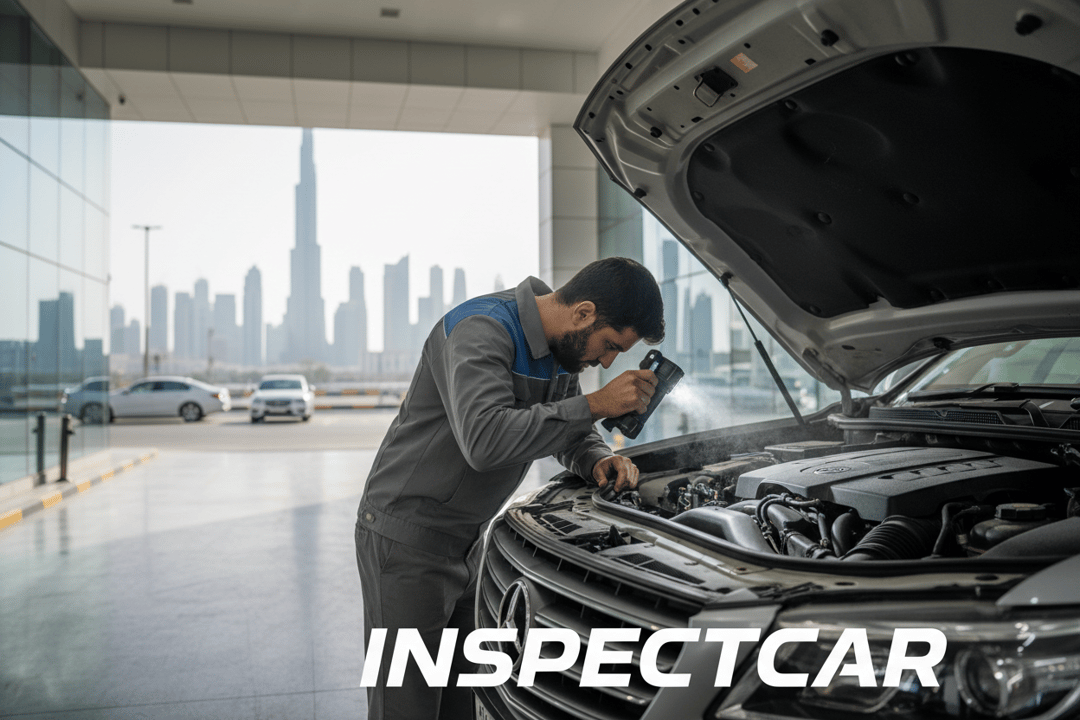
The moment a used car wakes up , that single short window between turning the key and the engine settling into idle, gives a trained inspector more honest information than the next twenty minutes of driving. Cold starts hide nothing. The engine has not warmed up yet, the computer has not had time to compensate, and any weakness in the starter, the fuel system, the sensors, or the electronics surfaces immediately.
This is the first category in our 25-category, 410-plus-checkpoint inspection. Eight focused checks, every one of them a clear pass or fail, every one of them worth thousands of dirhams in negotiation power if you know what to look for.
Why the engine-start window is the most honest test
UAE used-car sellers know buyers test-drive at 11 a.m. when the car has already been started, parked, and warmed up at the showroom an hour earlier. A pre-warmed engine masks rough idle, slow crank, hard start, smoke, and warning lights that would scream during a true cold start. Our inspectors insist on a genuine cold start, engine off for at least four hours, because that is the only condition where a problem cannot hide behind a warm ECU.
Below are the eight checkpoints we run, in the exact order we run them, and what each one reveals about the car you are about to buy.
The 8 engine start & operation checkpoints
1. Engine Starts and Idles
Four states: Normal, Rough Idle, Hard Start, Not Starting. We listen to the cranking duration, the moment of catch, and the first 30 seconds of idle.
- Normal: the engine catches in under two seconds and settles into smooth idle within five.
- Rough idle: shaking, uneven RPM, vibration through the steering wheel: points to fouled spark plugs, vacuum leak, dirty throttle body, or a failing coil pack. Repair: 600 to 2,500 AED.
- Hard start: long crank, multiple attempts. Often a weak fuel pump, leaking injector, or low compression. Repair: 1,200 to 6,000 AED.
- Not starting: walk away or expect a 5,000 to 15,000 AED diagnosis-and-repair pathway.
2. Remote Start
If the car came with remote start from the factory, we test it. Working, Not Working, or N/A. A non-functional remote start usually means a body control module (BCM) issue or a smart-key reprogramming problem, neither is a five-minute fix at the dealer. If the seller insists "the battery is just dead in the key," ask them to replace it on the spot before the inspection ends.
3. Push-Button Start
Same three states. Push-button systems fail at the brake-pedal switch, the steering-lock module, or the start-button itself. A push-button that needs three presses is not a quirk, it is the BCM warning you that something underneath is wearing out. Replacement modules are dealer-only on most premium brands and run 2,000 to 4,500 AED installed.
4. Check Engine Light
The single most-cleared warning before a sale. Three states matter to us: Off, On, Flashing.
- Off: noted only when we have confirmed the bulb itself works (it must briefly illuminate when the key turns to the ON position).
- On (steady): at least one stored fault. Could be a 60 AED oxygen sensor or a 12,000 AED catalytic converter. We do not guess, we read the codes.
- Flashing: active misfire happening right now. Driving the car with a flashing CEL destroys the catalytic converter within minutes. Do not test-drive. Negotiate or walk.
Inspector tip: a seller who clears codes immediately before the inspection leaves a tell-tale "readiness monitor not ready" status on the OBD scanner. We catch that every time.
5. Warning Lights
Six states: None, ABS, Airbag, Oil, Battery, Multiple. Anything past "None" needs a full OBD scan and a written disclosure from the seller.
- ABS light: wheel-speed sensor or hydraulic-control-unit fault. 800 to 4,500 AED.
- Airbag/SRS light: the system will not deploy in a crash. This is a safety-critical fault and a regional inspection failure. 1,500 to 8,000 a notable sum sometimes more if a clock-spring or impact sensor needs replacement.
- Oil light at idle: low oil pressure. Could be a sensor, could be a worn-out oil pump. The difference between those two conclusions is the price of an engine.
- Battery light: the alternator is not charging. Continued driving will leave you stranded within the day.
- Multiple: often a collapsed alternator or low system voltage triggering false warnings on every module simultaneously.
6. Gauge Cluster
Three states: All Working, Partial, Not Working. We watch every needle sweep on power-up and every digital segment illuminate. A dead fuel gauge or a stuck temperature needle is not cosmetic, it removes the driver's ability to detect a developing problem. Cluster repairs on European vehicles routinely cost 3,000 to 9,000 AED.
Watch for tampered odometers too. A cluster that has been swapped to roll back mileage often shows mismatched plastic, fresh torx-screw scratches, or a "service-required" notice that does not match the displayed kilometres.
7. Vehicle Starts/Stops Safely
Two states only: Yes or No. Does the engine start without rolling, without lurching, without stalling immediately? Does it shut off cleanly when you turn the key off, no run-on, no diesel-style after-fire on a petrol engine? Run-on after key-off in a petrol car points to carbon build-up or a sticking injector. Stalling on shut-down can be an idle-air-control valve. Both fail this checkpoint.
8. Abnormal Engine Noises
Four states: No Noise, Slight, Moderate, Severe. With the bonnet open, engine at idle, we listen with a stethoscope at six points: valve cover, timing-chain cover, oil pan, water pump, alternator, and accessory-belt tensioner.
- Ticking (light, regular): often a hydraulic lifter waking up, clears within a minute on a healthy engine; persists on a worn one.
- Knocking (deep, rhythmic): rod-bearing wear or low oil pressure. Engine teardown territory.
- Whining (rises with RPM): power-steering pump or supercharger.
- Hissing: vacuum leak. The car will run rich, fail emissions, and burn excess fuel.
- Squealing: belt or tensioner. 200 to 800 AED if caught early; thousands if a snapped belt destroys valves on an interference engine.
How this checklist protects you as a buyer
Eight checkpoints, executed in the first three minutes after a true cold start, will tell you more about the long-term health of a used car than any test drive a seller stages for you. The point is not to find a perfect car, almost no used car passes all eight without notes. The point is to know exactly what you are buying, what each finding will cost you to fix, and how much room you have to negotiate.
An InspectCar Engine Start & Operation report gives you each of these eight items rated on the same five-tier scale used across the rest of the inspection: Excellent, Good, Minor, Major, or Other. Photographs and OBD scan results back every Major finding. The report is delivered as a shareable digital link within 24 hours, often within the same business day.
Book the inspection before you pay the deposit
The single most expensive mistake we see in the UAE used-car market is paying a deposit before an independent inspection. Once any money has changed hands the seller has zero incentive to negotiate on a hidden engine fault. Our inspector comes to the car wherever it is: Dubizzle listing, dealer lot, seller home: across Dubai, Sharjah, Ajman, Ras Al Khaimah and Umm Al Quwain. The full Comprehensive 410-plus-checkpoint inspection (which includes everything above plus the other 24 categories) takes 2 to 3 hours on site. Stand-alone Computer Diagnostic and Body & Computer packages are also available for narrower needs.
Bring the engine-start checklist with you on every viewing. You may not save every car, but you will save yourself from the wrong one.





0 Comments
No comments yet. Be the first to share your thoughts!